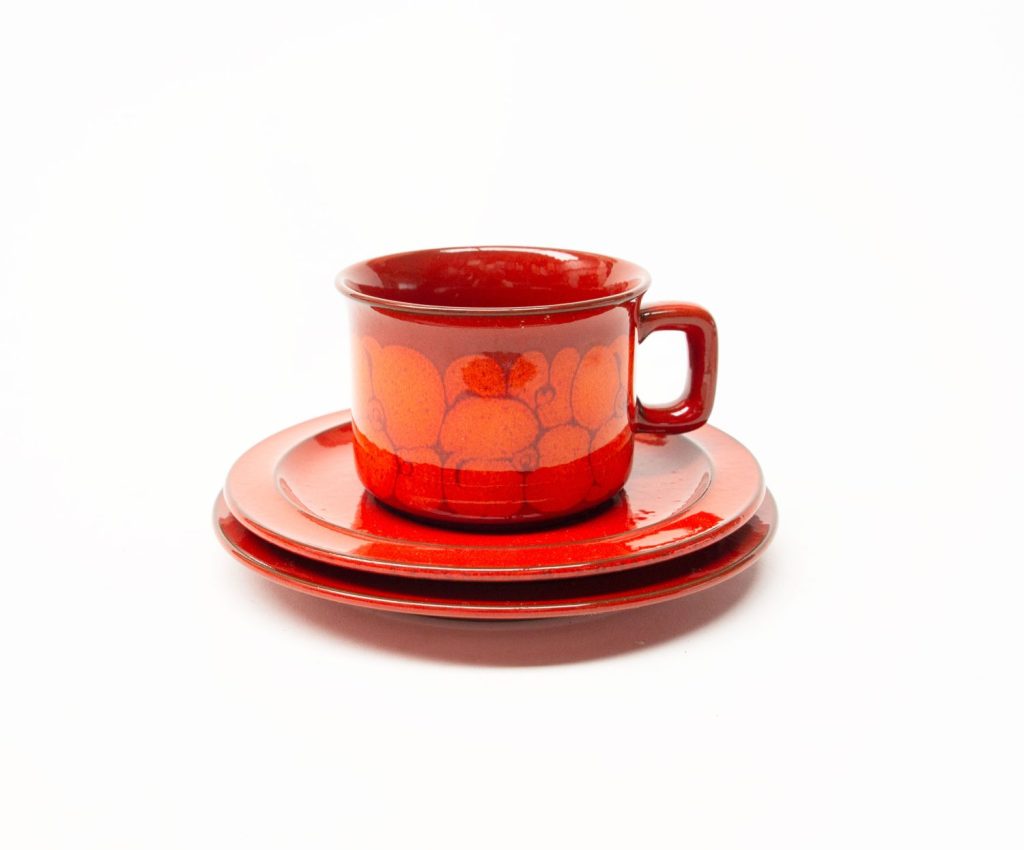
“Abbednaes” is a small pottery in Dianalund west of Copenhagen. It was originally owned by a Kurt Olsen who purchased the existing business in 1952 , and gave it the name Abbednaes Potteri. He was very talented and knew the old traditions of pottery and was also a good teacher.
Many of the students that came to Abbednæs learned from Kurt, and now have their own potteries.
Abbednaes is now run by Annegrete Rasmussen who came to work with Kurt from High School in the later 1990s. She produces a range of domestic pottery items with lovely decorative patterns. Read more
I have been fortunate over the years to come across several pieces by important Danish studio Potter, Gutte Eriksen. Her work stands out to me due to her use of simple glazes and a limited colour palette. The clay which she mixed herself, has a characteristic Zen “earthiness” and texture.
From 1955 she worked mostly with a specific glaze, which was a combination of borax, quartz, clay and ash. The recipe for this glaze was developed by British potter Michael Gill, and developed furhter by Gutte. This glaze produced a large range of colours which were created by firing techniques of controlling oxygen, flame and kiln placement. The resulting colours were a subtle a range of blues, greys, and reddish brown, The borax used in this glaze also gives her pottery a characteristic appearance, sometimes with whitish coloured “frothing” – much like you see on Japanese “Raku” pottery. Decoration was kept simple on pieces which Gutte created, restricted to simple oxide brushwork on the glaze, and use of simple impressed repeat patterns on some pieces.
The biography information below comes from the site Galerie Beson in the U.K. which closed in 2001, but remains as an important archive for those interested in important studio pottery of the 20th Century.
Gutte Eriksen influenced a generation of Danish potters with both her work and teaching. She taught at the Jutland Academy of Fine Arts, Arhus, in 1968-71, 1973-4 and 1976-8. Her public commissions include fountains in Østre Landsret and Holstebro. In 1972 she won the Gold Medal in Faenza and in 1985 she was awarded the Thorvald Bindesbøll Medal of the Danish Academy of Fine Arts.
In 2000 she was given The Prince Eugen Medal, awarded by the Swedish Royal Family for outstanding artistic achievement. She was honoured with a major retrospective at the Vejen Kunstmuseum in 2001.
Gutte Eriksen was born in 1918 in Rødby on the island of Lolland in Denmark. She studied at the Kunsthåndvaerkskolen in Copenhagen from 1936 to 1939. In 1941 she set up a studio with two other artists in Hareskov, moving to her own studio in Kastrup the following year.
In 1948 she spent two months working with Bernard Leach in St Ives, and later that year she worked in France with Pierre Lion and Vassil Ivanoff. From 1953 she worked in her studio at Karlsminde.
The influences of Bernard Leach and the Japanese potters can be clearly seen in her work and the approach to her work. She visited Japan to work with potters there in 1970 and again in 1973.
Below are the photographs of pieces I have had by Gutte. In photo 2 you might be able to see the handle or “ear”, which is Gutte’s cypher or stamp – the letter “G”which has been mostly covered by the glaze. Other pieces she simply signed “Gutte”.
Gutte Eriksen Studio VesselGutte Eriksen Studio Vessel – Her markGutte Eriksen Studio Vessel , side viewGutte Eriksen BeakerGutte Eriksen Beaker base shot, showing her cypher a bit more clearly.
Ursula Printz came to Sweden from Germany at the age of 17, and In 1939 became a student of Wilhelm Kage at Gustavsberg.
Due to her outstanding skills and knowledge she became director of the painting department at Gustavsberg in 1942 where she stayed until 1951 when she moved to the Royal Copenhagen factory Denmark. While at Royal Copenhagen she also met her future husband Jorgen Mogensen.
In 1953 she moved to her own studio in the town of Holte in Demark, where Jorgen joins her in c1964-5.
From this studio they both continued to work for many years.
Ursula’s work is characterised by the strong use of pattern and brushwork.
Her work from Gustavsberg is usually signed “UP”, “Printz,” “Ursula”, and occassionally simply a painted yellow snake. At Royal Copenhagen for studio pieces used “Ursula P”, often together with the year. In her own workshop she used most often signed her work simply “Ursula”
Ursula Printz Mogensen, Own Studio, Lamp – Photo Lauritz.comUrsula Printz Mogensen – Slab Jar, Own StudioUrsula Printz Mogensen – Slab BottleUrsula Printz Mogensen – Studio SignatureUrsula Printz Mogensen, Gustavsberg Jar via freeformsusa.com
The group of images below of Urusla’s work below Swedens National Museum of Art & Design which has a large collection of her work online HERE
Gustavsberg Bowl, decor Ursula Printz -Swedish National Museum of Art & DesignGustavsberg Jar, decor Ursula Printz -Swedish National Museum of Art & DesignGustavsberg Plate, decor Ursula Printz -Swedish National Museum of Art & DesignGustavsberg Plate, decor Ursula Printz -Swedish National Museum of Art & DesignGustavsberg Pitcher, decor Ursula Printz -Swedish National Museum of Art & Design