Skip to content

Posts from the ‘Palshus’ Category

Palshus Denmark

Palshus Denmark

Palshus Pottery was founded by husband and wife team Per Linnemann-Schmidt and Annelise Linnemann-Schmidt in 1947 in the town of Sengløse just west of Copenhagen, Denmark.

Per came from a strong artistic background, having graduated from the Royal Academy of Art in Copenhagen in 1931 and subsequent work as a sculptor.

The studio name is an acronym of P(er),(A)nnelise  (L)innemann, (S)chmidt and HUS (house).

The first items to be produced at Palshus were commercial wares in collaboration with Jens Quistgaard – being “Cherry Heering” Barware/Ashtrays for the Peter Herring Company, which they produced in very large numbers.

The early studio pieces from the studio were precise and minimalist in nature, with beautifully silken, matte haresfur glazes – mostly in subtle tones of either brown, blue, green or cream. The simple glazes and forms were a combination of Japanese and Scandinavian influences. Per was self taught in glaze technology and perfected these now iconic Palshus haresfur glazes. Per also often designed and drafted many of the forms and glazes and worked with other craftsmen and Annelise to realise the pieces.

Palshus Haresfur Glaze Bowl

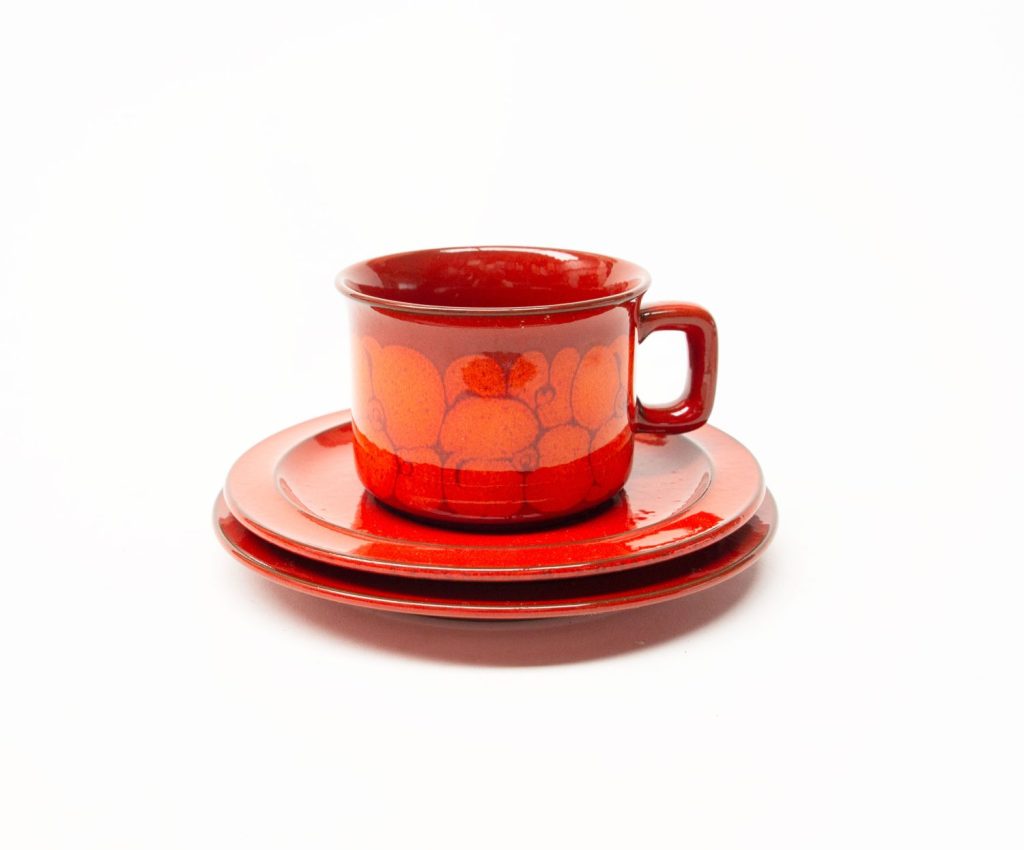
At Palshus the 1960s saw a change in style with the use of chamotte (textured clay) along with impressed/sgrafitto patterns, used in conjunction with more roughly textured,  glossy glazes.

Much of the output of Palshus was sold through Den Permanente in Copenhagen – as was the work of many important potters, craftsmen and artists at this time.

Palshus pottery is well marked with “Palshus Denmark” along with an inscribed number or number letter combination (which I believe is the form/shape number), and often a glaze or oxide colour number which is painted (rather than inscribed) on the base as a number or alpha-numerical code.

It will also have either Per’s or Annelise’s (or both) cyphers (PLS, ALS, APLS)….. but in the 1950s and 1960s several talented artists, sculptors and designers also worked at Palshus – including Kjeld Jorden (figurines), Jens Quistgaard, Billy Eberlein and Hugo de Soto (Artist/Painter).

The pottery closed in 1972, three years after the sad death of Annelise in a car accident at the age of 51. Per and Annelise had three children and five grandchildren including the ceramic artist/sculptor Annelise Linnemann-Schmidt (named after her grandmother) now back in Denmark after studying and working in the UK for several years.

Palshus Haresfur Glaze Bowl
Palshus Haresfur Glaze Bowl Base
Palshus Chamotte Vessel
Palshus Chamotte Vessel with glossy, textured glaze
Palshus Haresfur Glaze Bowl
Palshus Haresfur Glaze Bowl in Celadon Green
Palshus Chamotte Vase with Impressed Decoration via DanishHome Etsy
Palshus Chamotte Vase with Impressed Decoration via DanishMood Etsy
Palshus Items - Den Permanente Catalogue 1967
Palshus Items – Den Permanente Catalogue 1967 Via Royal Danish Library Archives
Palshus Items - Den Permanente Catalogue 1967
Palshus Items – Den Permanente Catalogue 1967 – Via Royal Danish Library Archives

Identifying Royal Copenhagen & Other Danish Makers Factory Seconds

It is important to know if you are spending a lot of money on a piece of Royal Copenhagn if it is a factory first or factory second, as often the appearance of the piece will give no indication of it being a “second” quality piece. Any pieces coming out of the Royal Copenhagen (and Aluminia) factories which did not meet the standards of perfection were market as “seconds”.

This was done by etching a very fine short line, through the 3 Royal Copenhagen lines with a diamond cuter. A second mark will usually mean that the piece is worth less depending on the rarity and popularity of the piece, as seconds were sold at a 25-30% discount .

The pieces I come across most often marked as seconds are those from the 1950s and 1960s from the Tenera and Baca series under the direction of Nils Thorsson. Some designs in these series were inconsistent in how they fired in the kiln – and if too far from the desired look, they were marked as seconds and sold in the factory outlets. In other cases pieces could be marked as seconds because of tiny firing cracks (figurines mainly) or other small faults. However sometimes there seems to be nothing at all to indicate why it is a second.

Often this marking is invisible to the naked eye unless it catches the light, so with every piece of Royal Copenhagen it is best to run a finger over the back stamp, and you will feel immediately if the piece has been marked as second quality.  Sometimes the fault is visible, sometimes not.

The second marks are very hard to photograph because they are usually so fine – but you should be able to make them out in the images below:

Royal Copenhagen Second Mark
Royal Copenhagen Second Mark – you can just make it out across the centre of the 3 RC waves.
Aluminia (Royal Copenahgen) Factory Second Marking
Aluminia (Royal Copenhagen) Factory Second Marking – just visible through the centre of the 3 waves.

Update 2023 – I notice that DPH trading now has an interesting article and youtube video on RC Seconds and also Employee marked Royal Copenhagen items HERE 

If you are interested in what all the other marks on the backstamp of a Royal Copenhagen pieces actually mean, including how to date when they were made – then go to the official Royal Copenhagen website.

Many people do not realise that not only Royal Copenhagen marked their second quality items. Soholm Pottery on Bornholm for example also marked their second quality items – with quite strong scratched or etched lines on the base of the product. Usually the flaws on a Soholm piece are easier to detect than with Royal Copenhagen seconds. This practice doesn’t seem to have been consistently applied though – as I often come across pieces with obvious glaze flaws which aren’t marked as seconds.

Soholm Denmark, Factory Second Marking
Soholm Denmark, Factory Second Marking – you can clearly see the lines through the Einar Johansen cypher here.

Other Danish makers I have come across who marked factory or studio seconds in this manner are Palshus and Dansk Designs

Palshus Denmark - Studio Second Mark
Palshus Denmark – Studio Second Mark (right hand side of base on the photo)
Dansk "Flamestone" Sugar Bowl
Dansk “Flamestone” Sugar Bowl with a factory second mark on the base (left hand side of photo – 2 short lines)