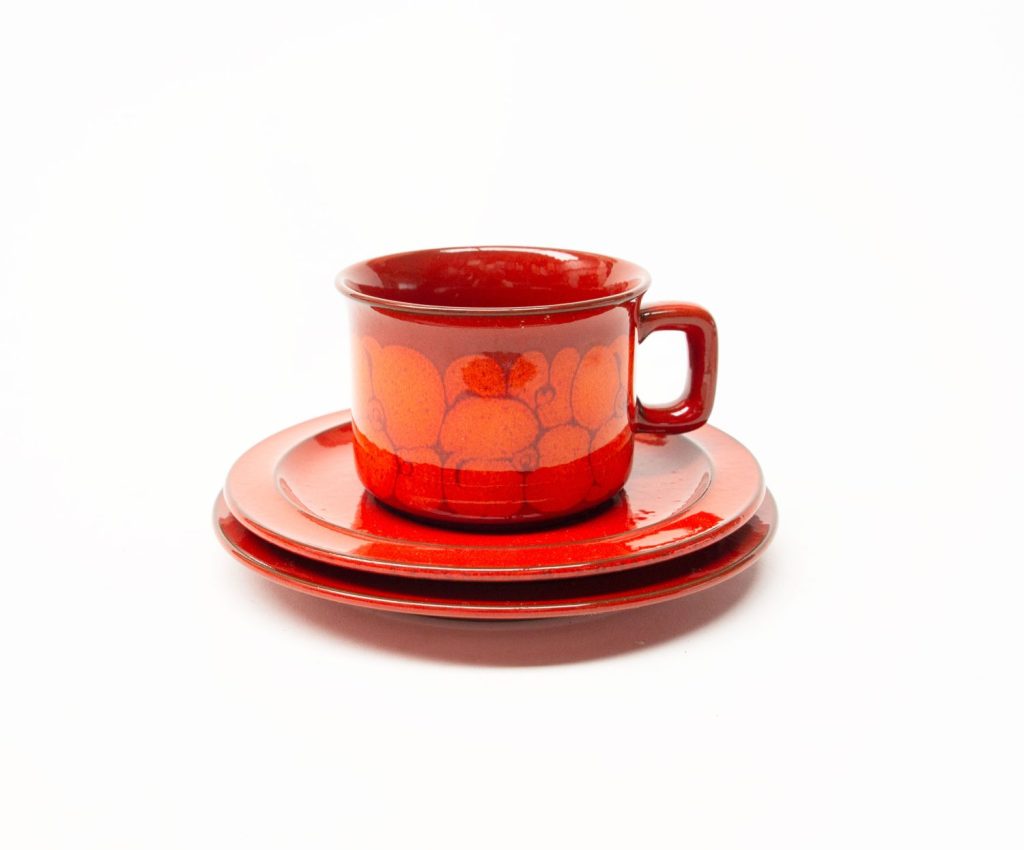
I come across works by Annette From, Denmark c 1970s and 1980s from time to time, but not much has been documented about her work and life.
Annette was born in 1931 in Denmark, and passed away in 2016. She was active until the day she died. Annette exhibited widely in Denmark between the 1960s and 1990s – but surprisingly little of her work is seen on the market these days. Some readers of this website have kindly sent me some photos of her work though.
Annette studied at Danmarks Designskole after which she was a enrolled at the Royal Academy of Art in Copenhagen. Her training as a potter was completed in 1951 after having been taught by Nathalie Krebs (Saxbo) and others, and she set up her own studio in 1963.
The thrown forms I have seem made by her are from the 1970s and 1980s, and are solid, well made pieces with uncomplicated glazes. These thrown forms are made with have heavily textured clay as I find with quite a lot Danish Studio Pottery.
Her free-form sculptural pieces pictured below are also interesting, especially when grouped together in different ways – creating different interactions and small sculptural vignettes. While there are only 2 in a group below, they dont appear to have been made as “sets” and any number could be arranged in any manner.
If any readers of this site have work by Annette, I would love to see it – contact me via email or post to the facebook page for the website.
It is important to know if you are spending a lot of money on a piece of Royal Copenhagn if it is a factory first or factory second, as often the appearance of the piece will give no indication of it being a “second” quality piece. Any pieces coming out of the Royal Copenhagen (and Aluminia) factories which did not meet the standards of perfection were market as “seconds”.
This was done by etching a very fine short line, through the 3 Royal Copenhagen lines with a diamond cuter. A second mark will usually mean that the piece is worth less depending on the rarity and popularity of the piece, as seconds were sold at a 25-30% discount .
The pieces I come across most often marked as seconds are those from the 1950s and 1960s from the Tenera and Baca series under the direction of Nils Thorsson. Some designs in these series were inconsistent in how they fired in the kiln – and if too far from the desired look, they were marked as seconds and sold in the factory outlets. In other cases pieces could be marked as seconds because of tiny firing cracks (figurines mainly) or other small faults. However sometimes there seems to be nothing at all to indicate why it is a second.
Often this marking is invisible to the naked eye unless it catches the light, so with every piece of Royal Copenhagen it is best to run a finger over the back stamp, and you will feel immediately if the piece has been marked as second quality. Sometimes the fault is visible, sometimes not.
The second marks are very hard to photograph because they are usually so fine – but you should be able to make them out in the images below:
Royal Copenhagen Second Mark – you can just make it out across the centre of the 3 RC waves.Aluminia (Royal Copenhagen) Factory Second Marking – just visible through the centre of the 3 waves.
Update 2023 – I notice that DPH trading now has an interesting article and youtube video on RC Seconds and also Employee marked Royal Copenhagen items HERE
If you are interested in what all the other marks on the backstamp of a Royal Copenhagen pieces actually mean, including how to date when they were made – then go to the official Royal Copenhagen website.
Many people do not realise that not only Royal Copenhagen marked their second quality items. Soholm Pottery on Bornholm for example also marked their second quality items – with quite strong scratched or etched lines on the base of the product. Usually the flaws on a Soholm piece are easier to detect than with Royal Copenhagen seconds. This practice doesn’t seem to have been consistently applied though – as I often come across pieces with obvious glaze flaws which aren’t marked as seconds.
Soholm Denmark, Factory Second Marking – you can clearly see the lines through the Einar Johansen cypher here.
Other Danish makers I have come across who marked factory or studio seconds in this manner are Palshus and Dansk Designs
Palshus Denmark – Studio Second Mark (right hand side of base on the photo)Dansk “Flamestone” Sugar Bowl with a factory second mark on the base (left hand side of photo – 2 short lines)