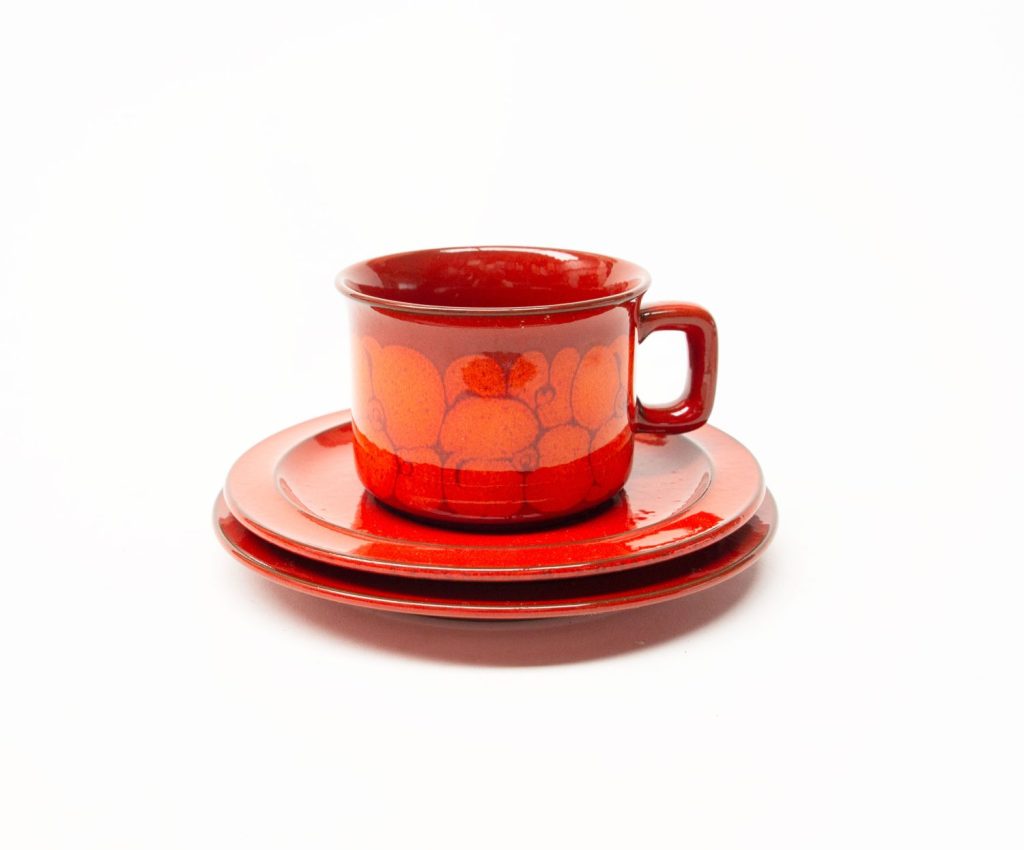
Thorkild Ohlsen (1890-1973) was a Danish landscape painter and porcelain designer who produced a number of significant porcelain dinner services for Royal Copenhagen beginning in the early 1930’s.
Ohlsen was originally employed by Royal Copenhagen Porcelain in 1908, and was an important collaborator of Nils Thorsson. He continued to paint and exhibit his work during his lifetime.
At Royal Copenhagen he worked with both modeling and decoration, especially over-and underglaze painting, and he participated in the development of glazes. In his early work, a series of crackle ware from 1920 , is the decoration of iron red and gold, usually with botanical motifs.
I think one of the most elegant dinnerware ranges he designed was “Fensmark” c1930s– named after a town in Denmark of the same name. It is also known by its pattern number “1010”. It was in production for decades and the forms were used on a number of dinnerware series.
The botanical drawing seems to be of “Quaking grass” in flower. The shapes in this range are beautifully elegant, and so typical of the late Art Deco period, with shapes starting to round off a bit, but with features such as Ziggurat style steps still present.
Other important dinnerware designs produced by Ohlsen included Quaking Grass, Dagmar, Liselund, Georgina, Primavera, and Wheat Cereals (blanc de chine)
In 1924-5 Bourne-Denby as the British company was then known, introduced a decorative line called “Danesby Ware” of which the “Electric Blue” range was one of the outstanding and most popular lines. The Electric Blue glaze captured a new age of optimism and cheerfulness coming out of years of darkness during WW1
Originally inspired by the shapes of an Aladdin’s lamp, the outstanding feature of this range was the beautiful blue streaky and high gloss glaze. It was produced well into the 1930’s, and is still popular amongst collectors today.
Being stoneware it has lasted incredibly well, and the pieces I have photographed here are in superb condition. You can often fine Electric Blue in online stores in the U.K., and in Canada. The vase forms pictured here are probably the ones you will find most often – but there are some beautiful large jug forms which are much harder (and more expensive) to find.
They are such classical, elegant and beautiful shapes. Read more
Michael Andersen and Sons Pottery (MAS), Bornholm Denmark.
Michael Andersen & Sons was founded in the 1880s (from an earlier 18th Century Pottery) on the island of Bornholm, Denmark – one of the major centres of Danish pottery production during the 19th and 20th Centuries.
Jens Michael Andersen (1859-1931) who was the founder, had trained at the local Hjorth pottery.
His 4 sons worked in the pottery, and one son, Daniel (1885-1959) developed the iconic “Persia” glaze in 1935, which won an international award. The Persia glaze went on to be used on many designs well into the 1960s.
Persia Glaze Bowl with design by Marianne Starck, M.A.S. Denmark – The cat designs by Marianne Starck on different forms with a Persia glaze have become very collectable pieces.Michael Andersen & Sons, Lamp with Persia Glaze – A simple blue pattern on the Persia glaze like this one seems to show it of to best effect – highlighting the lovely mother-of-pearl crackle of the glaze
It is the “Art Pottery” of the 1950s -1970s which MAS are now best known for worldwide…but I also love some of the Art Deco style designs from the 1930s – although these are harder to find in excellent condition now.
Michael Andersen & Sons, Art Deco Era Bowl
Marianne Starck originally from Germany, was one of the top Ceramicists who contributed to the success of Michael Andersen & Sons Pottery in the mid 20th Century.
She started with the Factory as Artistic Director in 1955 and remained until its closure in 1993, designing many iconic series of which the “Negro” series is probably one of the most coveted now.
“Negro” Series Bowl, Marianne Starck, M.A.S. There are a large number of designs in the “Negro” or “Tribal” series – all very striking in design
Marianne’s work is usually inscribed with the initials M.S.
Michael Andersen Denmark, MS signature for Marianne Starck
Since 1930 items from MAS have usually been marked with the three fish stamp in various designs. Sometimes it is a simple label, other times just an impressed mark of 3 herrings.
Michael Andersen & Sons Denmark, 3 Herrings Paper Label
The 3 herring mark is also the official seal of the town of Ronne, where the factory was located.
The M.A.S. pottery was partly resurected by ceramicist Solveig Ussing, and it operates currently from a small workshop in Ronne, where some of the original MAS moulds are still used.
The photographs in this article are of pieces that have passed through my hands, so of course they only represent a fraction of all of the designs made.
Stoneware Bowl, Michael Andersen & Sons, Marianne Starck Design. The stoneware pieces from the 1960s and 1970s also have a presence and quality which set them apart from the rest.Marianne Starck Wall Plaque, M.A.S.Michael Andersen & Sons, Large Stoneware BowlMichael Andersen & Sons, Stoneware Bowl. These small stoneware forms from the 1960s – often with blue glaze, and textured clay are amongst my favourites from M.A.S.
OR If Etsy is unavailable, or you would prefer eBay - follow the link below (click on the image) . Basically the same items are listed, at the same price.