Knud Khyn was a an accomplished Danish painter, draughtsman and ceramic sculptor. My interest in his work lies in his evocative, superbly modelled ceramics.
He worked at Royal Copenhagen over several periods - c1903-1910, c1924-1932 and c1936-1967.
He also worked at Herman Kähler's Pottery c1920-1924 and also at Bing & Grondahl 1908-1915 and 1933-1935.
His animal figurines capture so so well the mass and expression of his subjects, in addition to capturing the essence of their characters, how they move, and how they play.
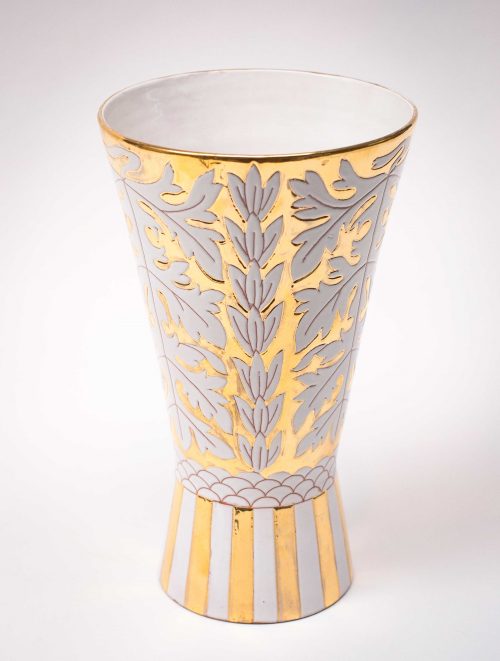
There were a number of incarnations of the Zaccagnini company, Italy. The large vase in the image below would have been made by “Urbano Zaccagnini Artistic Ceramics” which operated from 1958 to the mid 1960s.
The Zaccagnini name is very well known in the United States, but not so well known or seen here in Australia. In the U.S. much of the Zaccagnini output is referred to as being in the “Hollywood Regency” style – highly decorative, often with a bit of “bling”. The company is also well known for its collectable Disney characters which were made for Disney by “Zaccagnini SpA” from the 1930s. In addition Zaccagnini is well known for its animal figurines and ceramic statuettes.
Zaccagnini seems to have reached its peak in the 1940s and 1950s, and it is the work from this era which seems to be the most coveted (and thus expensive to buy) – you will often find beautifully simple Modernist works from this era by Zaccagnini on places like 1st Dibs.It is a maker, however which is often easily mis-attributed if there is no makers mark – as there are so many similarities between Italian makers during this era.
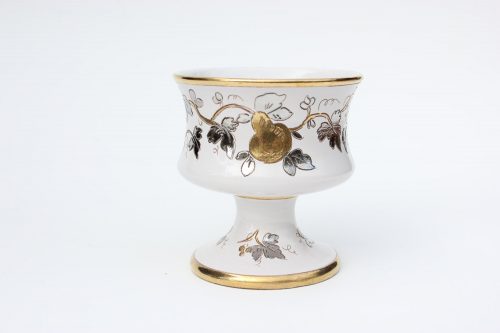
Zaccagnini, Italy Bowl via “apythagorasplace” etsy
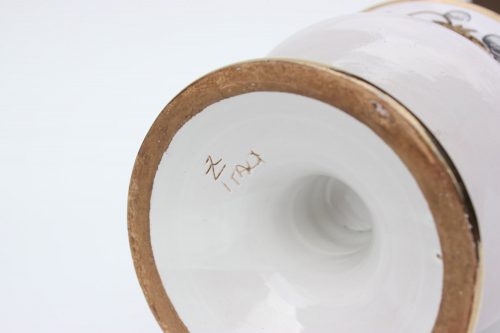
Zaccagnini, Italy Vase Cypher on above piece.
There is a brief history of this important Italian maker on THIS website which also has images of many of the backstamps and cyphers used.
Here is a (google) translation of the entry:
The ceramic factory “Ugo Zaccagnini & Figli” was founded by Ugo Zaccagnini, a former employee of “Richard-Ginori”, in Sesto Fiorentino in 1905. The first production of the company is focused on the production of majolica and earthenware type, often inspired by the ancient Della Robbia models.The company, with which the five sons of Zaccagnini Urbano, Pietro, Prisco, Adele and Enrichetta collaborate, moved to Florence in 1912 where he began a production of more volumes presenting at numerous editions of the Triennale and the Milan Trade Fair. at the Florence Crafts Exhibitions. In the 1930s the sculptor L. Contini collaborated with the manufactory.
Among the important ceramists who worked for the manufacture we also remember the sculptor Fosco Martini who, around the mid-thirties, made many interesting ceramics depicting animals and the majolica painter U. Ciardella. In 1936, after the death of the founder, the factory changed its name and became “Società Anonima Ceramiche Zaccagnini” with its headquarters in Piazza Pier Vettori 10, Florence and the role of managing director and artistic director was entrusted to the major of the heirs Urban. In the same year, thanks to the capital introduced into the company by the industrialist Aristide Loria, the company became a joint-stock company and invested in modernization and production capacity.
In 1937, more than 120 employees work in ceramics and in the factory, and the factory begins to export its products to the United States. In the second half of the Thirties the collaboration with the manufacture of numerous artists including: Mario Bandini, Ottorino Palloni, Maurizio Tempestini, Gino Pozzi and Leopold Anzengruber.At the end of the Thirties, Walt Disney entrusted “Zaccagnini S.p.A.”, which in those years was based in Piazza Pier Vettori 10 in Florence, the ceramic construction of the characters of their cartoons.
In 1950 some of the company’s ceramics, including a series of dishes, were exhibited at the Italian Crafts Exhibition at the Brooklyn Museum in New York.
In the fifties an artistic line inspired by abstractionism, called “Swedish”, was included in the production.
In 1958, Urbano Zaccagnini left the family factory and founded the “Urbano Zaccagnini Ceramiche Artistiche” which remained active until the mid-1960s.
The “S.p.A. Zaccagnini” is still active until the year 2000.
Arne Bang is known for his exquisite stoneware ceramics, but he was also an important sculptor and silversmith.
It is the ceramics of Arne Bang which I am attracted to. His focus was on technical excellence and innovation – and the uniqueness and beauty of his designs are as relevant today as they were in the 1940s.
Arne was the brother of glass designer and architect Jacob E. Bang – who is often confused and whos work is often mis-attributed to Arne’s son Jacob Bang (1932-2011) also a potter, sculptor and designer.
Arne was formally trained in Sculpture, after which he had a very successful collaboration with ceramicist Carl Halier – it was with Halier that Bang learned extensively about glazes.
In 1929 Arne Bang started at Holmegaard Glassworks, where he started up the production of Holmegaards Stentøj (Stoneware). His aim was to create quality ceramics which collectors would appreciate, but which the every day person could also afford.
From 1948 Holmegaard Stentøj became Bangs’ own company, but from 1953 he worked from his own workshop in Fensmark, Denmark.
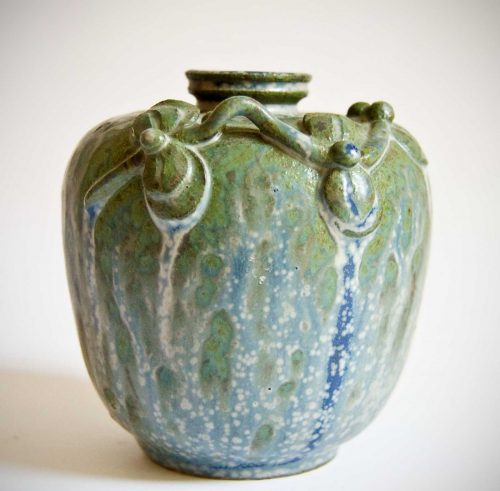
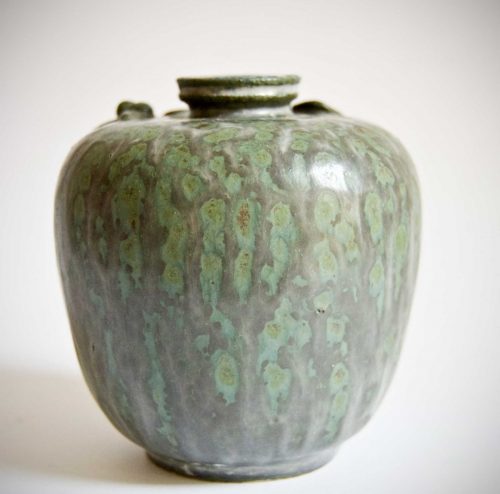
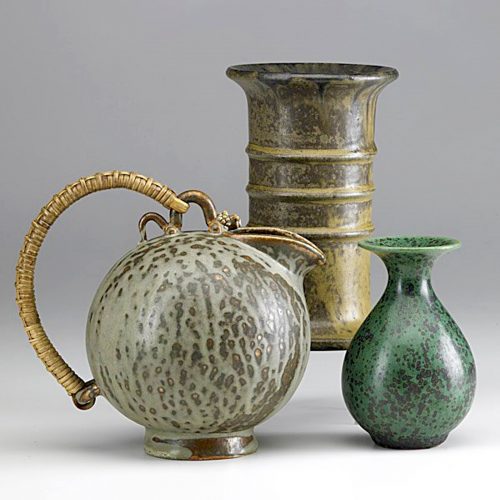
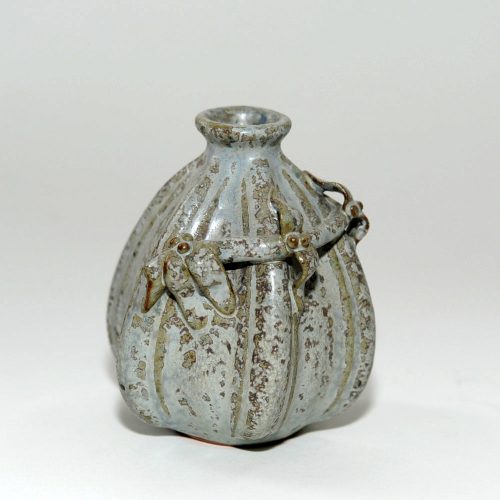
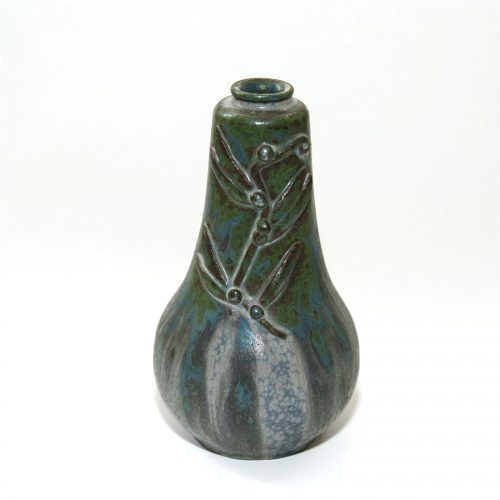
The work of Arne Bang has a very sculptural quality and unique presence. His work is enhanced by the use of superbly textured glazes in muted luxurious tones. Some of these glazes are often referred to as “crocodile” or “birds egg” glazes.
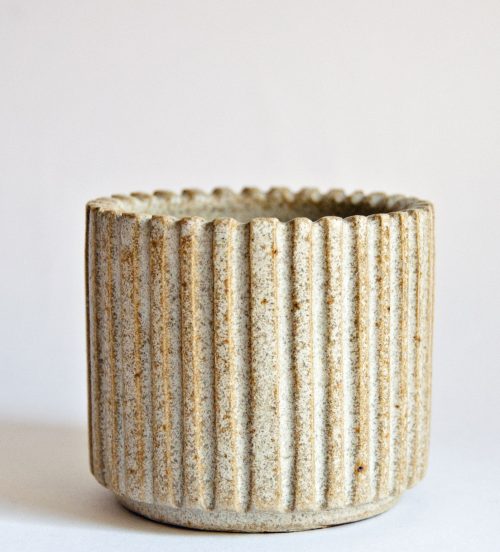
His forms are often very organic with sensuous, bulbous shapes – and he often the use of ribbing as a decorative feature. Some pieces were also designed with silver components such as lids, spoons etc – in collaboration with silversmiths.
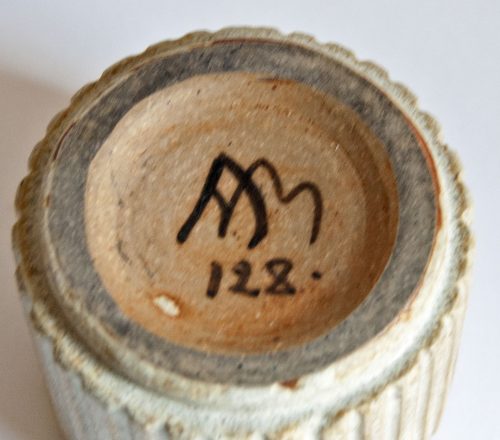
On most Arne Bang studio pieces you will find a model number painted on the base – the lower the number, the earlier the piece. The studio pieces are also signed with a distinctive AB signature.
You can read more about the Bangs at the Bang Family Website HERE (in Danish)
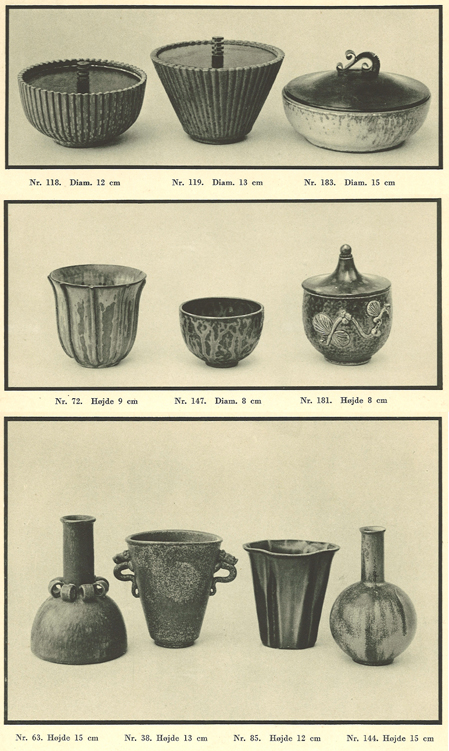
There is also comprehensive Arne Bang Database online via the Vejen Art Musuem in Denmark, which even has some early Arne Bang Catalogues – especially interesting are the 1932 & 1937 catalogues.
Arne Bang SignatureVia LiveAuctioneersArne Bang, 1937 Catalogue Entry
2. Jacob Bang (1932-2011)
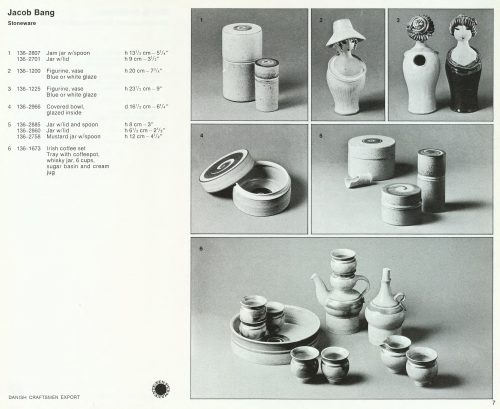
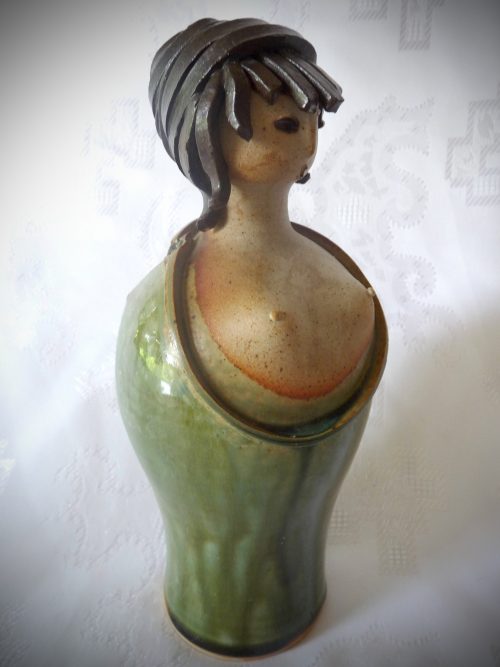
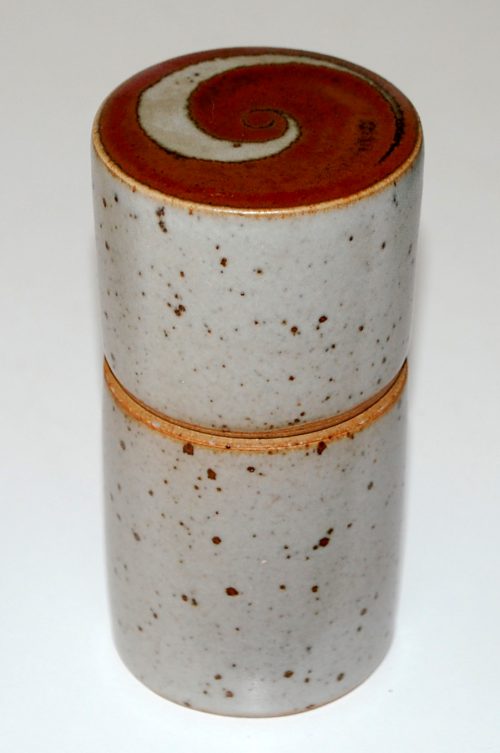
Jacob Bang was a Danish ceramicist, designer and sculptor and the son of Arne Bang. He was primarily trained in his father’s Fensmark studio which he later took over (1965-81).
In his early career he worked for 6 months or so with Bjørn Wiinblad (1955) and as a designer at Hegnetslund Lervarefabrik (1957-62). From 1981 he work exclusively with Sculpture and Art, and he had a workshop in Copenhagen from 1981-91 where he worked from.
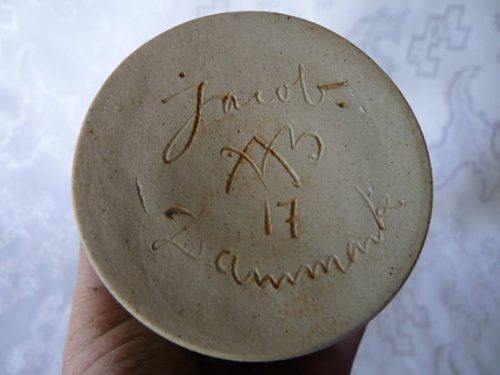
Work made by Jacob while working in Arne Bang’s studio will have both the Arne Bang studio cypher – AB – and Jacob written above it.
Jacob was well represented at Den Permanente in Copenhagen, which I have written about previously.
The first image below of a piece I have by Jacob, is a very elegant candle holder which appears to be a very early piece, using one of Arne Bang’s glazes.
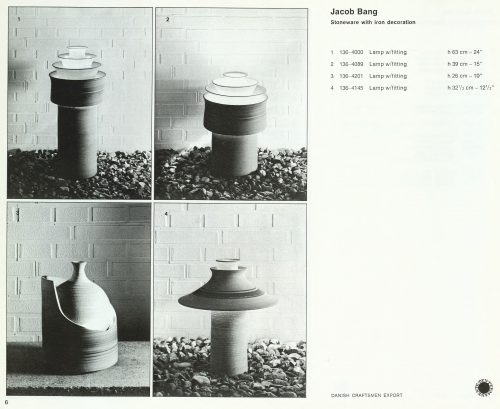
Jacob Bang Ceramic Lighting, Den Permanente Catalogue 1972Jacob Bang Den Permanente 1972Jacob Bang SignatureJacob Bang Denmark – similar to examples in Den Permanente Catalogue above.