Skip to content

Hjorth Pottery Denmark – Ulla Hjorth

Ulla Hjorth (b. 1945), the daughter of Eric Hjorth (who in turn was great grandson of founder Lauritz Hjorth 1834-1912) started at Hjorth Pottery on Bornholm, Denmark, in 1962 and worked there until its closure in 1992. Along with her sister Marie Hjorth, they were the last operators of the Hjorth Pottery from 1982 until its closure and then development into a museum  in 1992-1995. 

Ulla’s work is beautifully functional and elegant at the same time. I especially love her lidded forms. The decoration she chooses compliments, and is united with the form, and is not merely “surface decoration”. The decoration often consists of a combination of simple geometric forms with beautifully brushed line-work, on top of a simple stoneware glaze. 

Her pottery as far as I am aware is all stoneware, with simple timeless glazes.  

When doing a bit of research for this entry I noticed that the Bornholms Musuem has an updated entry on Hjorth Pottery entitled “The Women at Hjorth’s Factory”. 

In the section on potter Ulla Hjorth it says:

Ulla was educated at the School of Arts and Crafts in Copenhagen in 1969 and is very much into the functional. The factory’s tradition was combined with new impressions from the School of Arts and Crafts. Ulla Hjorth works with stoneware and mainly manufactures utility items in simple, classic shapes and glazes. Her work has been characterized as utility ceramics with qualities beyond the purely practical. “I emphasize that a teapot must be functional and that it is united with the shape” she said.

See previous articles on L Hjorth pottery in the navigation table to the right of the page. 

Ulla Hjorth Denmark

Ulla Hjorth Denmark – Photo Ray Garrod

Ulla Hjorth Denmark

Ulla Hjorth Denmark – Photo Ray Garrod

Ulla Hjorth Denmark

Ulla Hjorth Denmark – UH signature, along with LHjorth. Photo Ray Garrod

Ulla Hjorth

Ulla Hjorth – Photo via BonrholmsMusuem.dk


Ulla Hjorth Denmark

Ulla Hjorth Denmark – Photo via Pinterest (missing attribution)

Ulla Hjorth

Ulla Hjorth Denmark, Photo via Pinterest (missing attribution)

Ulla Hjorth Denmark

Ulla Hjorth Denmark – Photo via Pinterest (missing attribution)

Hornsea Summit

Recently I came across a very smart early Hornsea design in the form of a lidded butter dish. It is from the Hornsea “Summit” series – designed 1960, produced 1962 -1965. It’s designer of course John Clappison.

The summit series was very popular in its day with its modern tapering forms, fluted over the full height of the item with colour inlays of either apricot, turquoise, charcoal or terracotta on a white ground.

The glaze colour in the ridges was applied by hand on bisque fired pieces with a sponge and then wiped off – resulting in glaze colour being left only inside the ridges. The whole piece was then glazed with a transparent glazed and  re-fired to higher temperatures

Pieces in this series will have an impressed stamp on them indicating the form number – this butter dish is 260.

There are 19 forms in the series, consisting of things like cruets, egg cups, sugar bowl, mustard pots, bon bon dishes etc.

One thing that strikes me about these pieces is they are surprisingly fine and delicate for earthenware, which really compliments the fine and beautifully considered design.

Hornsea Summit Butter Dish, Photo Ray Garrod
Hornsea Summit Group
Hornsea Summit Group – Photo via The Sale Room
Hornsea Summit
Hornsea Summit Group – Photo via MyPotShots.blogspot

Cinque Ports Pottery

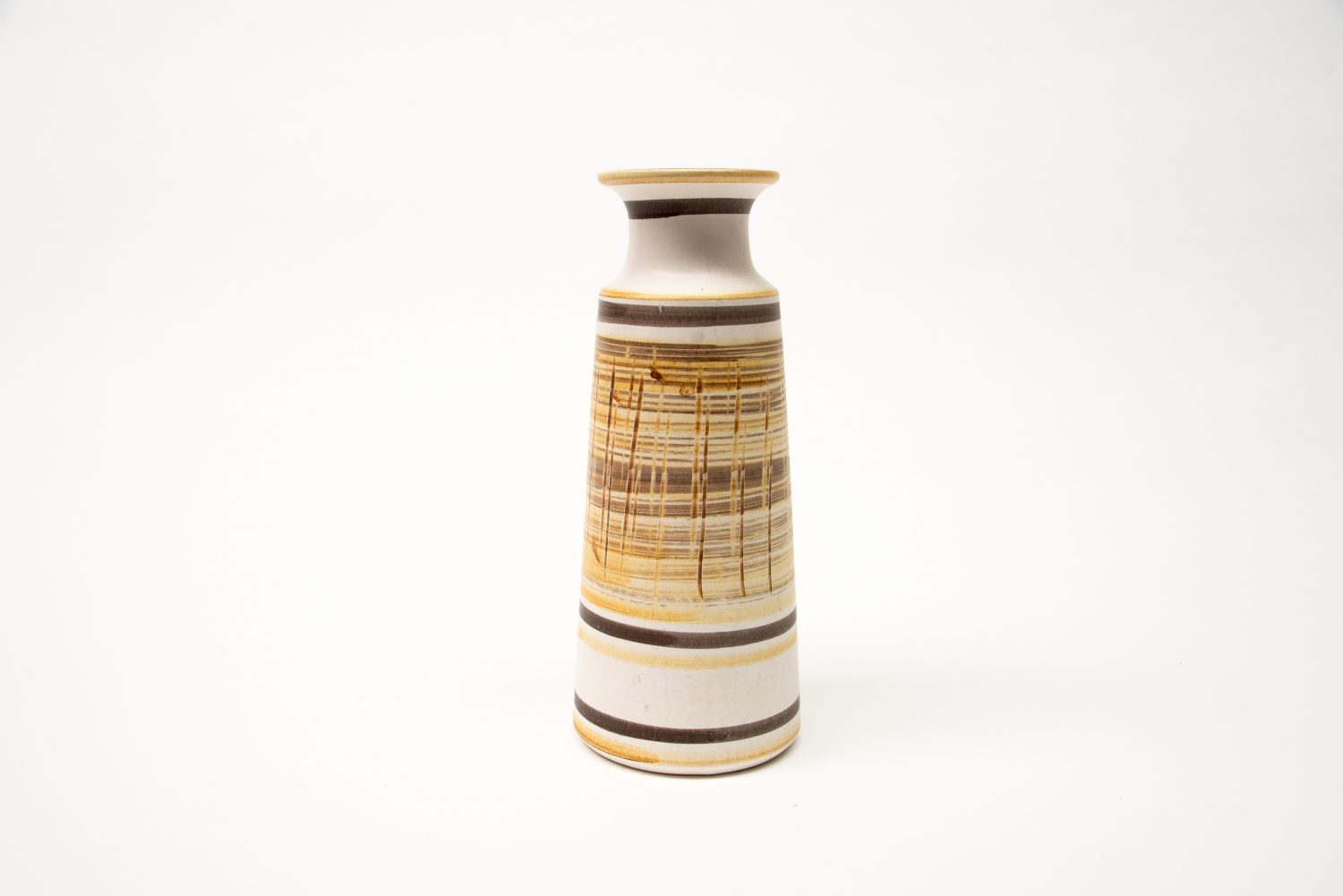
I came across the striking vase in the first images recently, and was immediately attracted to it. From the distance I thought it might have been a piece of Lapid Israel pottery, but on closer inspection it turned out to be British – by Cinque Ports Pottery Ltd, The Monastery. It is a pottery I knew next to nothing about so did a quick bit of research and in the process found some quite lovely pieces of British Mid Century pottery. (Cinque Ports is a historic series of coastal towns in Kent, Sussex and Essex U.K.)

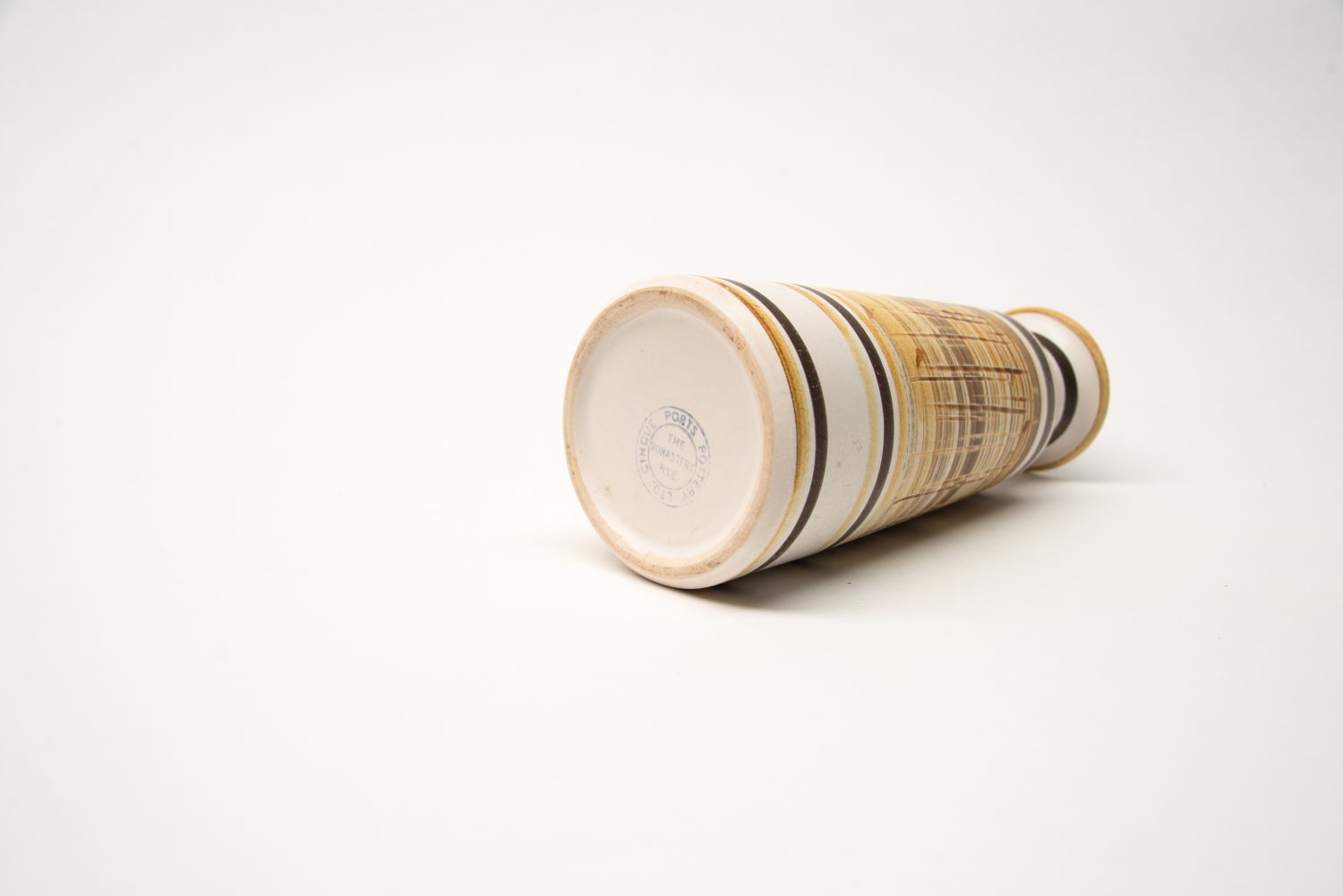
Cinque Port Pottery was founded by David Sharp in 1956 with George Gray…the name was later changed to Cinque Ports Pottery Ltd and changed later again include the name of the operating premises at “The Monastery” when George Gray took over this incarnation of the pottery in 1964, after an amicable split between the two owners.

In the 1980s the pottery was handed over to a Jim Elliot, first trading as Cinque Ports Pottery, without the ‘Limited’, then later as Cinque Ports Ltd, without the “Pottery”

The pottery operated until July 2007 until its final closure.

From what I can see the pottery was a high quality slip cast, and appears to be stoneware fired or at least high earthenware fired. Some of the output reminds me of Briglin Pottery London, and other pieces remind me of the potteries of Cornwall and Rye. As I mentioned earlier it also reminds me of Lapid Pottery, with its use of hand painting, and high quality stoneware fired, slip cast pottery.

If searching for this pottery online the autocorrect of many search engines will change to totally unrelated things – the worst in case is the Etsy search function.  To get any results on the Etsy search function you need to use the words “Cinque Port Pottery” to get any results.

The names and locations of this pottery can be a bit confusing, but you can read a more comprehensive history on the Studiopottery.com site or in the book “The Potteries of Rye: 1793 Onwards, Carol Cashmore” pub 1999 if you can locate a copy. (out of print)


Cinque Ports Pottery, The Monastery, Vase 1970s

Cinque Ports Pottery, The Monastery, Vase 1970s, Photo Ray Garrod

Cinque Ports Pottery, The Monastery, Backstamp

Read more