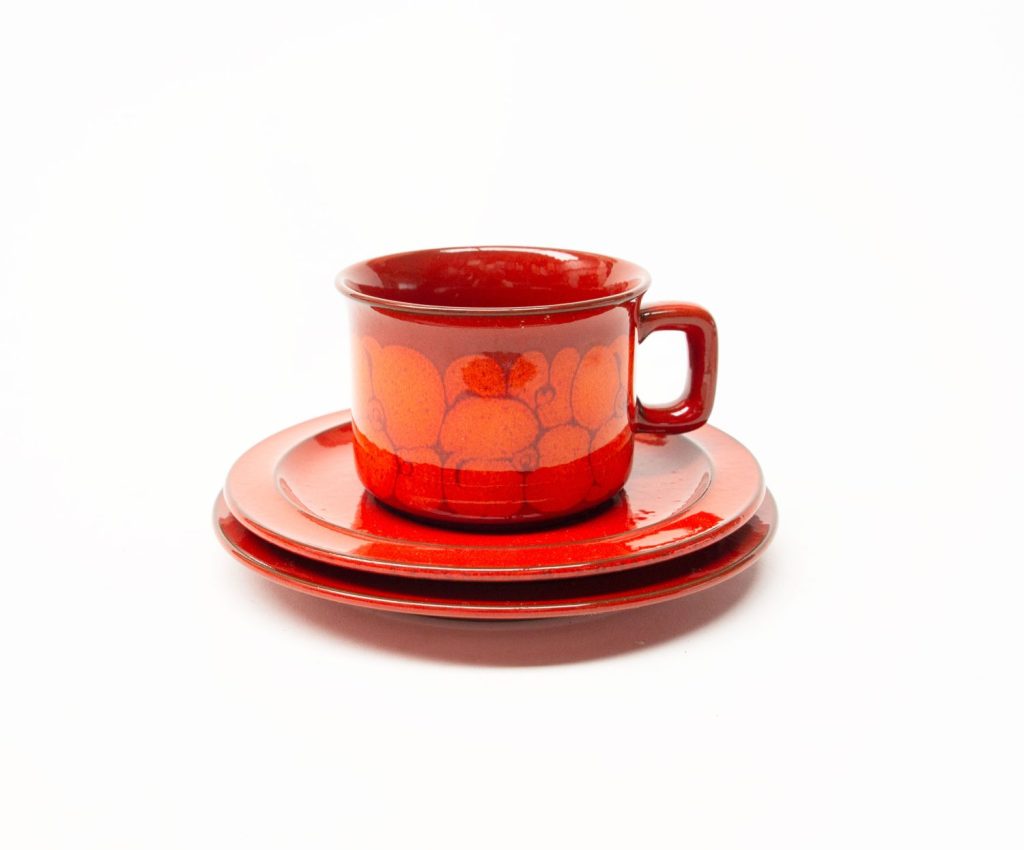
Lyngby Porcelain opened in 1936 in Lyngby, a picturesque town just north of Copenhagen, Denmark. Neils Holst and Christian Knudsen were its original founders, and it was a major supplier of dinnerware to the Danish market from the 1950s until its closure in 1969, after which it was demolished. At its peak it had over 500 workers...subscribe to read more.
Denby Arabesque design by Gill Pemberton would have to be one of the 20th Centuries greatest dinnerware designs. Unlike many other dinnerware and production designs of this era and later Gill actually designed all the forms and the patterns – including the ergonomics of the handles and such.
Originally Arabesque started as a small set of gift ware designed by Gill Pemberton – with the same stylish and ergonomically correct handles as those on Chevron. A trip to Russia with her husband in 1962 inspired the idea for the red and golden hand painted decoration which she developed further. The design for Arabesque was bound to become a cultural icon of the 1960’s and 1970’s.
The Arabesque range was in production only 12 months after the Chevron range had started and continued in production for almost 20 years.
Despite its very high volumes, and appeal to the mass market – each piece was still hand painted until the mid 1970’s onto the unfired glaze when the sheer volume meant production methods needed to change and decals were then used.
The following is from Gill Pemberton herself to correct some common errors she reads about her 2 most iconic designs:
“Both Chevron and Arabesque were mostly hand thrown and turned , only later some smaller pieces were semi machine made . And no, the design on Arabesque is not enamel. The medallions on Arabesque were hand painted raw unfired glaze onto raw glaze. Later , as the design became so popular, the smaller items – most used pieces like cups & plates, the decoration was applied on fired glazed ware as a decal “
Gill thought carefully about every component in this series and even modelled all the handles spouts, to maintain consitency. The range was originally named Samarkand (which it continued to be in the U.S) but this had to be changed when at the same time Portmerion pottery produced a range by the same name.
Denby Arabesque Sauce Boat
The side handle design on Arabesque pieces is a further – slightly more organic development of the side handle on Chevron pieces, all designed by Gill.
The flared shape of the coffee cups and creamer matches the flared design of the Coffee Pots
Denby Arabesque Creamer
I really like the white satin glaze interiors of the cups, jugs and some of the other vessels – probably because it contrasts so well with the dark pattern – and highlights the design even more.
The design of all the plate sizes features this layout of the design. The chop plate (the largest of the plates was rimless -causing a few production headaches)
Denby Arabesque Plate Design
I continue to come across pieces that are hard to find – like the butter dish, and below that a set of ramekins in their original teak tray – (Photo provided by Martin in Canberra)
Arabesque continues to sell well on the secondary market, and is still popular and highly collectable, and relatively inexpensive. Its survival says a lot about its durability – like all Denby ware.
The work of Ejvind Nielsen has become highly sought after amongst collectors, and while you will find a number of pieces by Ejvind Nielsen for sale around the place, it is hard to find out much about him or his work.
What I have found is this though:
It is not clear where he had his apprenticeship – but he did spend some time in England in the 1930’s, and then in Spain as a volunteer after the Civil War.
Ejvind opened his own pottery in 1943 in Hvidovre, Denmark and it ran through until 1978 – but had enough stock to keep the shop open until the mid 1980’s. Sadly the pottery is no longer there, and a new house stands on the block.
Ejvind Nielsen, Jar FormEjvind Nielsen, Signature
Opening during the War meant supplies were quite short – so it seems he worked for a time at Royal Copenhagen under Thorkild Ohlsen, where he also met his wife Lizzi.
Thorkild and Lizzi took some time off for a sabbatical in 1964 in Africa, and this influenced a series of Wall plaques in addition to the other output from the pottery.
Apparently Lizzi designed the animals and the glazes were developed by Ejvind.
Below are the pieces by Ejvind Nielsen I have come across and documented.