Skip to content

Tuscan Fine China

Tuscan Fine China, England

Tuscan Fine China was founded 1878 Staffordshire, England by R. H. Plant. The Plant family were important potters back as far as 1775. They were a strong family business, well run by generations of family members, until 1967 when they were taken over by Wedgwood, who added the name “Royal” as a prefix.

Research and product development was very important to them like other successful English Potteries such as Denby.

There were 2 major technical developments at Tuscan in the 20th Century. First was the discovery of a very fine body suitable for hotel ware named ‘Metallised Hotel China’. This ware was very tough and fracture-resistant (discovered by technician and Art Director J. B. Clarke). There was also a china body with a faint pink shade which they called ‘Peach Bloom’.

Tuscan Fine China Pastels

What I love about Tuscan China is their outstanding use of colour and also pattern over the decades – especially the use of Pastel colours in the photograph above of a design probably from the 1950s. The quality of Tuscan bone china is also as good as it gets – it is very hard, fine bone china which holds the glazes and decoration beautifully.

Below is one of the highest sellers and most popular designs by Tuscan in the 1950s. Commonly known as “Du Barry Rose” or “Sunshine 001”. Still very popular amongst collectors. The pale pink base glaze is such a soft and luxurious pink – and not harsh at all link many pink glazes can be. Many couples received this set as a wedding gift in the 1950s.

Tuscan Fine China, Du Barry Rose

The yellow poppy design below is one of the most beautiful and delicate Tuscan designs I have come across, it also comes in a green variation.

Tuscan Fine China, Yellow Poppy

Below: Another fantastic poppy design by Tuscan. The design and shapes here indicate it would have been from around the 1930s Art Deco era.

Tuscan Fine China, Art Deco Design

It is difficult to find the names of these designs, often they just have a number on the base. Also there were over 30,000 designs produced during the company’s lifetime.

You may be able to find the name of a design by looking through sites such as replacements.com

If anyone knows of books or other resources with the pattern names for Tuscan Fine China I would love to know. The only publication I have found to date is on this website:

http://www.tuscananddecorocollectors.co.uk

There are some good sources to date the backstamps however and I use this good online resource for Tuscan China :

http://www.thepotteries.org/mark/p/plantrhsl.html

Thomas Germany, Eclipse

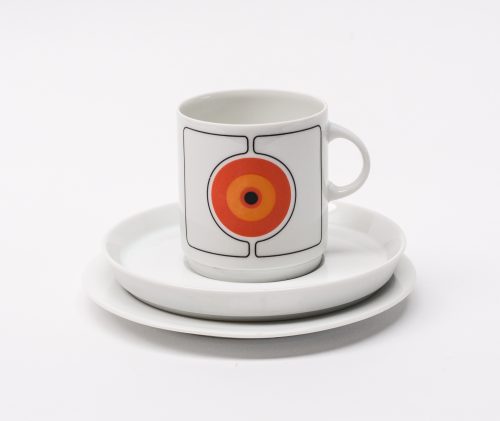
This very smart modernist op-art design is “Eclipse”, made by Thomas of Germany c1970s. (Part of the Rosenthal group) . The bold, crisp design was created by H.T. Baumann & Barbara Brenner for Thomas/Rosenthal.

Barbara Brenner worked for Rosenthal from 1960 to ?. Her “Scenario Metropol” and its strong “Memphis” style pattern, has become known as  her signature design.

Eclipse was one of several designs at Thomas during this era which had these typically white ground minimalist designs decorated with very bold and striking “op-art” patterns .

Thomas Germany, Eclipse Design

Thomas Germany, Eclipse Design

Thomas Germany, Eclipse Design

Thomas Germany, Eclipse Design

Thomas Germany, Eclipse Design

Thomas Germany, Eclipse Design

The following background on H. T. Baumann was kindly sent to me by Christine in the U.K. : Read more

Hornsea Lancaster Vitramic Contrast

Hornsea Pottery, Lancaster Vitramic “Contrast” has become a British design icon. It won the British Design Council awards for design in the 1970s. It features a stunning chocolate velvety matt brown glaze with a black gloss band and bright white interior. The forms are simple, elegant and beautiful – they remind me of the purity of the forms of Denby Chevron with its clean, elegant lines and forms.

A brief history of the design:

In 1972, after years of compromise by adapting and adding to their first factory, Hornsea Pottery needed to expand due to its success. A new (second) site was found and the official opening took place in 1976. The first three ranges produced at the Lancaster factory received Design Council Awards and with them Hornsea Pottery enhanced its already worldwide reputation.

Hornsea Pottery had marked its silver jubilee in 1974 by launching a celebration range of products and this led to a collaboration with Lord David Queensberry and Martin Hunt. Together, in 1974, they produced a very successful range of “Lancaster Vitramic” tableware designs, starting with Contrast.

The Contrast design was initially trialled at the Hornsea site, then produced at the Lancaster site, followed by the equally successful variations Concept, Ebony, Impact, Palatine and Cinnamon (produced exclusively for Harrods) plus there are several more variations including one where the black band is replaced with a glossy bright orange instead.

Below are some pieces of the Contrast design that have passed through my hands:

Creamer, Hornsea Lancaster Vitramic Contrast
Creamer Hornsea Lancaster Vitramic Contrast
Hornsea Lancaster Vitramic Contrast, Tea Cup/Saucer
Hornsea Lancaster Vitramic Contrast
Ceral Bowl,Hornsea Lancaster Vitramic Contrast
Main Plate, Hornsea Lancaster Vitramic Contrast

The following information is added from the Wikipedia entry for Hornsea Pottery – the website I oringinally used for this information – The (original) Hornsea Musuem – no longer exists online)

Unfortunately, there were many teething problems and it took factory workers longer to train to the higher standards required for the newly introduced brown Vitramic body. Despite this shaky start the first three ranges produced at the Lancaster factory received Design Centre Awards and with them Hornsea Pottery enhanced its worldwide reputation.The Lancaster site only lasted for twelve years. Despite overcoming the early difficulties and its eventual profit making, it could not stand up against the economic climate of the time. It closed in 1988.

Palatine Variation of Contrast.
Midas Variation, Hornsea Lancaster Vitramic Contrast
The Midas Variation of Hornsea Lancaster Vitramic Contrast