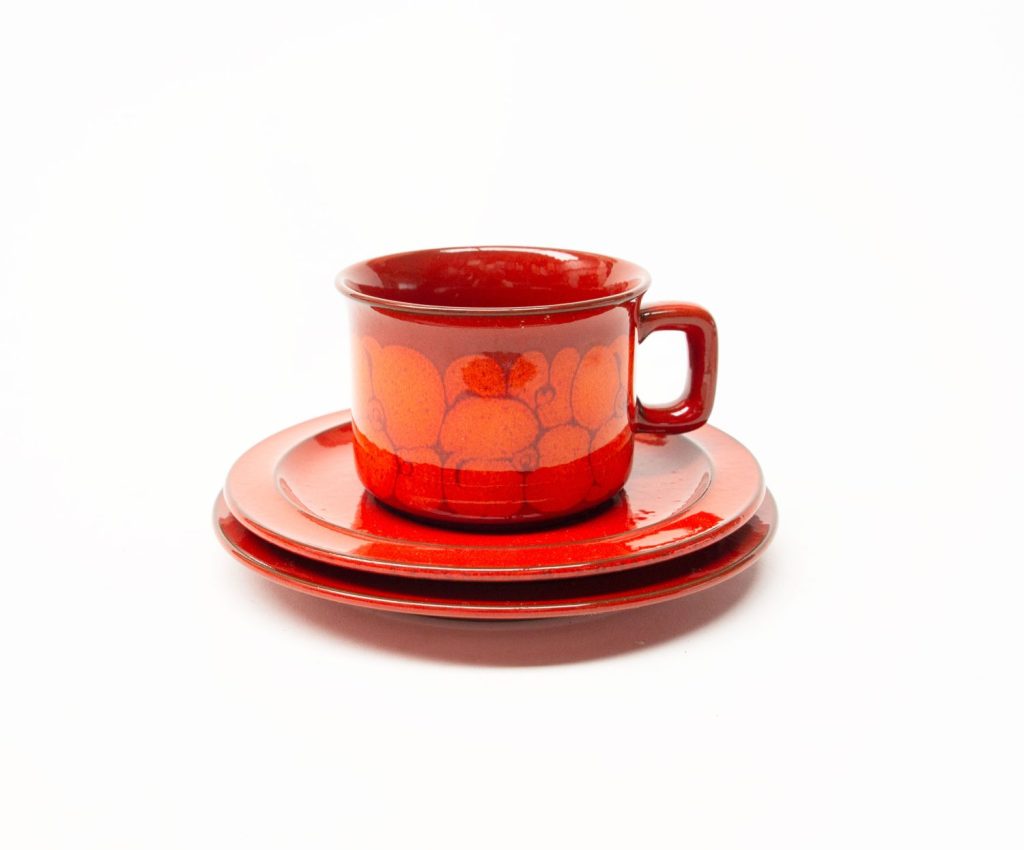
Derek Smith was a already an accomplished ceramic designer and art teacher in the U.K. when he moved to Australia in 1956.
He set up a studio and kilns while he was teaching at Bowral High School in the Southern Highlands of New South Wales, near Sturt Pottery where Smith developed working relationships with the potters there at the time.
Eric Juckert was a prolific Australian Studio & Commercial Potter and Artist/Painter who had studied with Una Deerborn in South Yarra, Melbourne. He worked as a potter and painter from around 1949 to 1992 in Victoria. His pottery was also sold by the department stores Myer and David Jones under the trade name “Jacqueline”.
It is worth reading a well researched biography on his life on the Australian “Rameking” blog HERE . A selection of his work showing the wide variety of styles he produced can also be seen at the local museum in Cowes, Victoria.
Juckert was a highly skilled potter, and well respected amongst his peers both nationally and internationally. I especially love his use of expert use of glaze colourants and surface texture. Even the smoothest of his glazes have a luxurious, tactile quality about them.
The pieces you will probably come across most often by Juckert in Australia are the small bottles with impressed circle designs, and the white “splatter” glaze commercial ware.
Eric Juckert Bud Vase with impressed circles and crackle glaze
Eric Juckert – Bud Vase with impressed design
Eric Juckert – Bud Vase, Manganese Glaze, Impressed Circle Design
Ulla (Ulrika) Procope (1921-1968) worked in Arabia’s art department at the same time as Kaj Franc, Kaarine Aho, and Goran Back. Initially she trained with Olga Osol in the hand painting department at Arabia, after graduating as a ceramicist from the Central School of Arts & Crafts in Helsinki. She worked at Arabia from 1948-1967.
Ulla was a skilled wheel thrower who understood how clay worked, and her outstanding design skills along with the ability to create production models, contributed to the success of Arabia in the 1950s and 1960s.
The Ruska range which she designed for Arabia Finland in 1960 became one of the best selling lines in their history. Its production was continued into the 1990’s it was so popular. It has become a Scandinavian design classic.
It was the first time Arabia had used a matte glaze for mass produced utilitarian ware. Ruska had a handcrafted look and feel to it, with the glaze colour and mottled appearance turning out slightly differently on each piece.
Arabia Ruska TeapotArabia Ruska Milk Jug CreamerArabia Ruska – Large Coffee CupArabia Ruska – BowlArabia Ruska – Wide Cup (Soup)Arabia Ruska – Coffee CupArabia Ruska Coffee PotArabia Ruska Cereal Bowl
Being stoneware it was also very tough and ovenproof. A trend at the time was ‘oven to table’ and Ruska was perfectly designed for this purpose.
Ruska captured the look and feel of an era in the 1960s and 1970s, and is still keenly sought after on the secondary market as replacements, and for those just discovering this classic Scandinavian design.
The same model forms (Model S) were used for the later Anemone and Rosmarin and Kosmos designs.
OR If Etsy is unavailable, or you would prefer eBay - follow the link below (click on the image) . Basically the same items are listed, at the same price.