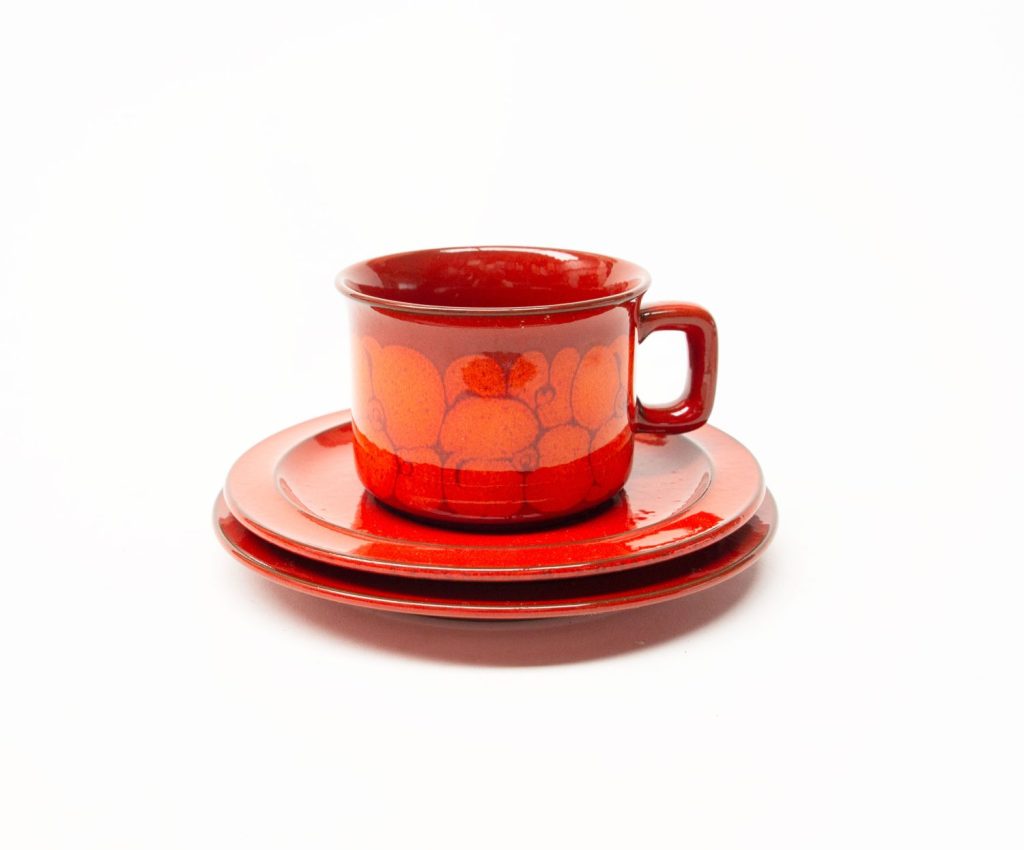
Gustavsberg Vardag
This design is called "Vardag", and was designed by Karin Björquist for Gustavsberg Sweden in 1955
Sep 5

This design is called "Vardag", and was designed by Karin Björquist for Gustavsberg Sweden in 1955
Oct 31

Stig Lindberg (1916-1982) was one of Sweden’s most important post war designers who created a number of now iconic 20th Century ceramic designs during his time with Gustavsberg Sweden.
One of the most striking I think is the Aster series of dinnerware he designed – which was released in 1972 in both red and blue variations. It was in production until 1974.
The combination of black outlining of the blue (or red) stylised aster forms really intensifies the boldness and attractiveness of the design. Especially with the contrast against the bright white of the porcelain. This use of black outlining to make a pattern “pop” can be seen in other designs by Lindberg such as “Bersa” (Green and Black)
The Aster series quickly became collectors items and was re-released by Gustavsberg in 2008 – but as with all re-releases, a slightly different pattern with updated forms and shapes. You can compare the original and new releases of the Aster design on the brilliant website of Mother Sweden

Stig Lindberg Blue Aster, Gustavsberg

Stig Lindberg Red Aster, Gustavsberg – Image via Lauritz.com
Apr 4

Ursula Printz came to Sweden from Germany at the age of 17, and In 1939 became a student of Wilhelm Kage at Gustavsberg.
Due to her outstanding skills and knowledge she became director of the painting department at Gustavsberg in 1942 where she stayed until 1951 when she moved to the Royal Copenhagen factory Denmark. While at Royal Copenhagen she also met her future husband Jorgen Mogensen.
In 1953 she moved to her own studio in the town of Holte in Demark, where Jorgen joins her in c1964-5.
From this studio they both continued to work for many years.
Ursula’s work is characterised by the strong use of pattern and brushwork.
Her work from Gustavsberg is usually signed “UP”, “Printz,” “Ursula”, and occassionally simply a painted yellow snake. At Royal Copenhagen for studio pieces used “Ursula P”, often together with the year. In her own workshop she used most often signed her work simply “Ursula”


The group of images below of Urusla’s work below Swedens National Museum of Art & Design which has a large collection of her work online HERE