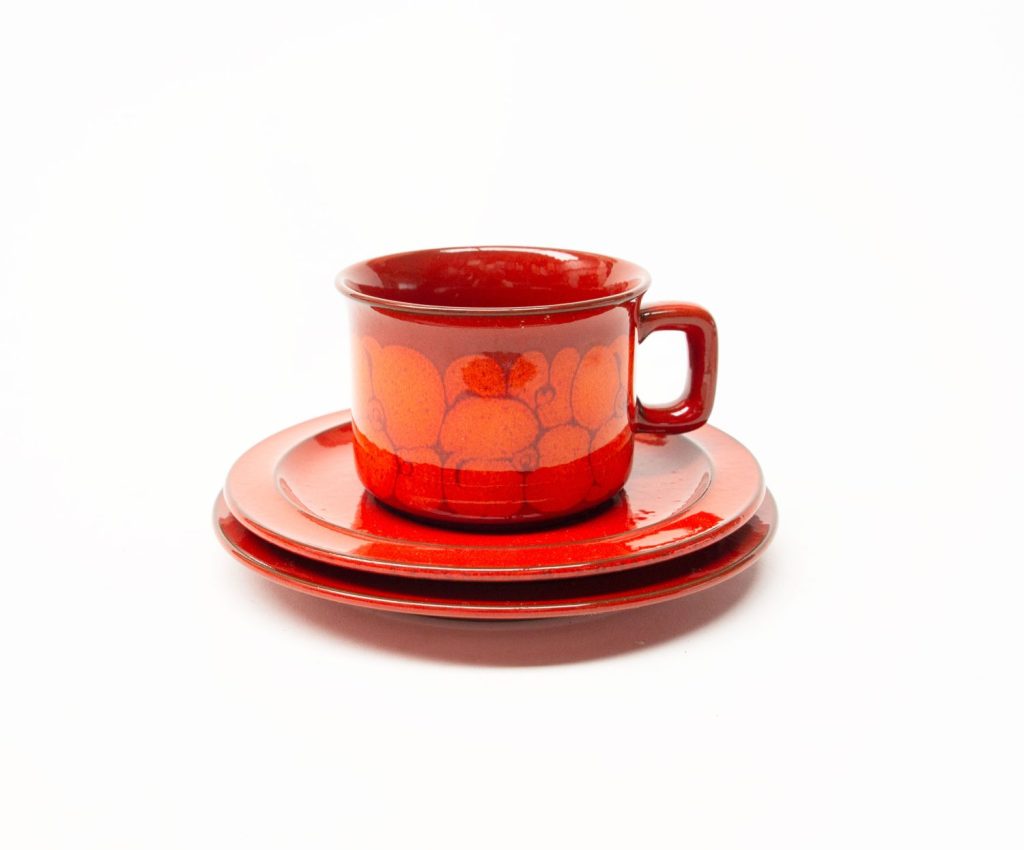
From time to time I come across beautifully formed stoneware forms from Denmark, stamped “TUE” in tiny letters underneath. Tue is the stamp of Tue Poulsen (b1939 -) a highly accomplished ceramicist and artist who has a permanent gallery and studio in Fårevejle, in the east of Zealand, Denmark.
Update October 2026. I read online the Tue passed away on January 14, 2026. His family remains active at his pottery and the Tue Poulsen website is still active at http://tuekeramik.dk.
His sculptural work is astonishing, but equally accomplished are his ceramic vessels – often produced in series. The first image below is of a piece I found recently at an Auction.
In addition to his own studio pottery, Poulsen has also designed pieces for Stogo (1963, 1976)), Torben Orskov (1963), lamps for Domus Danica (1970), furniture for Westnova (1973) and ceramics for Knabstrup (1973).
I have been slowly going through the digitised catalogues of Den Permanente, Copenhagen – held by the Danish Royal Library HERE
In the 1967 Catalogue I was interested to find some works by Herluf Gottschalk Olsen, who’s work is not widely known nor well documented. Read more about him in my previous post here.
During his relatively brief life he obviously had a profile, and was viewed as an accomplished potter to be able to have work for sale through the juried process of Den Permanente.
It’s good to be able to slowly build up an image library of works of this Danish Potter who could have so easily been lost to history.
Works by Herluf Gottschalk Olsen, Den Permanente Catalogue 1967, Royal Danish LibraryWorks by Herluf Gottschalk Olsen in the Den Permanente Catalogue 1967 – Royal Danish Library – Full Page
I also found another piece by Herluf on the online Danish auction site “DBA” from 2012:
I have written about Danish Potter Ejvind Nielsen previously HERE. He is well known for his beautiful stoneware animal wall plaques. I recently discovered this fascinating wall plaque by Ejvind Nielsen.
It is a depiction of the Bronze Age “Sun Chariot” – a very important Danish cultural icon, held in the National Museum of Denmark
I am guessing that this particular item would have been produced by Nielsen in the 1960s – but I have never come across it until now. It measures about 28cm wide x 20cm and has one of Nielsen’s often used brown glazes, but it is the lovely textured backbround that makes the design stand out so well.
The Sun Chariot was found in September 1902, when the former bog Trundholm Mose in northwestern Zealand was ploughed for the first time. The Sun Chariot was made in the Early Bronze Age around 1400 BC. The elegant spiral ornamentation that graces the golden sun disc reveals its Nordic origin. The Sun Chariot illustrates the idea that the sun was drawn on its eternal journey by a divine horse. A sun image and the horse have been placed on wheels to symbolize the motion of the sun. (National Museum of Denmark)
Wikipedia also has an interesting entry about the Sun chariot HERE.
The Sun Chariot is such an important Danish cultural icon that it is also featured on the Danish 1000Krone bank note released in 2011.
In the late 1950s, the Danish government commissioned Georg Jensen to precisely recreate the Sun Chariot in the original materials.
This was:
“for use by the state as a diplomatic gift. Only seven models are believed to exist, including chariots in the collections of the United Nations, the White House and the Finnish Parliament. The intended recipient of the present example was Soviet Premier Nikita Khrushchev, but deteriorating relations between Denmark and the Soviet Union led to the cancellation of the visit upon which he was to have received the Solvognen. Instead it was retained in the London offices of Georg Jensen”