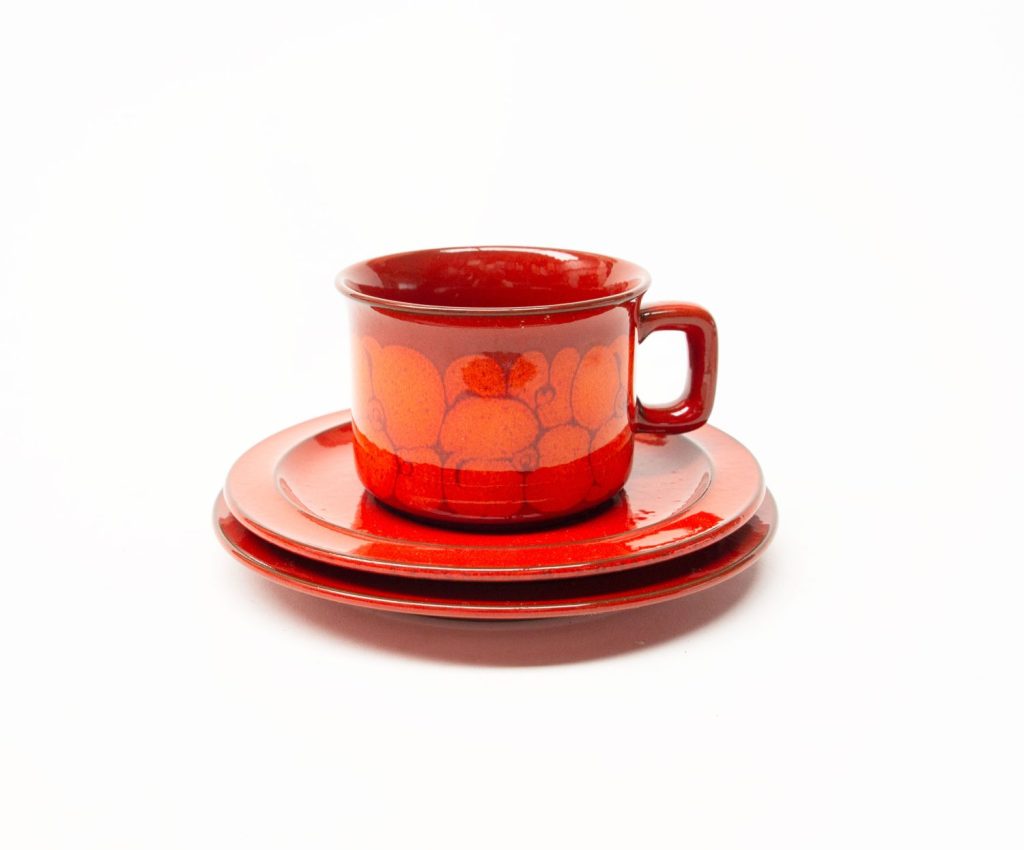
The Denby design “Romany” is from the 1970’s – but I don’t have an exact date.
Apparently this striking glaze came about from an accidental mixing of the wrong proportions in a glaze recipe – and when it was fired and shown to Glynn Colledge he loved the effects of the glaze with its runs and thicker brown areas on top of the “old gold” glaze…so it went into production as a range.
It has that very 1970’s handmade feel about it, and is yet still contemporary – especially with some of the forms such as the bowl in the first image. Some of the pieces of Romany display lovely colour runs in the glaze, and the colour can vary from piece to piece quite a bit as you can see below – but this all adds to the charm of the design I think.
The Romany glaze has a lovely satiny smooth feel to the touch as well. Denby pottery is also all very tough stoneware – so if cared for it will easily last for decades.
This article is a combination//summary of articles about Dybdahl Pottery, Denmark which I had posted on the previous incarnation of this website.
Further information will be added as I edit and add new information and photographs about the Dybdahl Pottery – much of it from the assistance of kind people who have helped me with over the past years including Belinda, Leif, Andy, Lasse and many more. A small book is eventually planned collating all of the information and photographs which have been gathered together.
Dybdahl Pottery, Denmark is one of the first Danish Potteries that really grabbed my attention. The patterns, decoration and unique nature of the forms and designs captivated me over 15 years ago when I first discovered it, and I continue to find new forms and decorations which I haven’t seen previously.
Briefly, Margrethe Dybdahl (1916-1999) worked together with her husband Palle Dybdahl (1918-2001) in their workshops in North Zealand, in the town of Allerød. Palle was educated as a potter at Holbæk Pottery Factory. He then studied at the Danish Design School where he graduated in 1936. He was also later a teacher at the Danish Design School for a period.
Margrethe was educated at the Rostrup-Boyesen Art School 1934-1936 and the Danish Design School 1936-1937 where she met Palle. Margrethe was never a potter but a very accomplished painter and decorator of pottery. It is probably the quirkiness and unique gentleness of many of her designs which attract me – she was able to communicate such joy and feeling with her painting and design.
Below: My first ever piece of Dybdahl Pottery – a stunning large teapot, beautifully decorated and constructed.
Dybdahl Denmark Teapot, Photo Ray Garrod
Palle and Margrethe had started up their first workshop together in Hørsholm 1952-1959. They had 2 to 3 apprentices here. They bought their house in Allerød circa 1958 and established a workshop in what was previously a stable next to the house. The house is located in a beautiful area surrounded by woods and was probably the inspiration for many of Margrethe’s nature motifs (insects, bees, spiders, birds, leaf patterns, etc.). They lived and worked here until they died, both at age 83, two years apart.
Dybdahl cat vase, photo Ray GarrodDybdahl Milk Jug – Photo Ray Garrod
At the peak of their production there were 9 people working in the Dybdahl Pottery, including Palle and Margrethe. Margrethe was the main decorator of the figurative pieces. They usually had 3 or 4 apprentices through a rotation, and one who was there the longest was Lasse Birk, who is still active in the town of Birkerød. Lasse continued to work for Palle after his apprenticeship was completed. Another apprentice at Dybdahls for a period was Andy Blick who kindly provided me with some lovely old photos below taken during his apprenticeship.
One of the most popular items of Dybdahl Pottery are the charming little birds in the forms of salt dishes, bowls, mustard pots etc. These are from the earliest days of the pottery – and were produced in large numbers and a variety of sizes and decorations. Another popular item which you can often find are the rectangular baking dishes – these were slump moulded pieces – and many of the moulds are still in use as they were left to Lasse Birk by Palle. These are hard earthenware pieces – fired to around 1180c – so have a different “sound” to stoneware when tapped.
Dybdahl Dish – Photo Ray GarrodDybdahl Tiles – Photo Belinda BelaireDydahl Sculptural Vessels – photo via Lauritz.com dk
Other popular items include tiles, bowls, dishes, sculptural pieces, and decorative items like large hanging eggs. The Dybdahls sold their pottery from their workshop and also from Den Permanente. They did not have an agent and sold everything themselves. They exported overseas regularly as well.
Every piece of Dybdahl pottery I have found has been signed “Dybdahl Denmark”, and will often have other information such as “ovenfast” (which the serving dishes), sometimes initials or other information.
Dybdahl Easter Eggs – Photo Belinda BelaireDybdahl Salt Cellar, Photo Ray GarrodDybdahl Dish – Photo Ray GarrodDybdahl Denmark, Large Dish – Photo Ray GarrodPalle Dybdahl taken by Andy Blick during his time at Dybdahl Pottery.Dybdahl Pottery – Photo Courtesy Andy Blick, Canada.Dybdahl Denmark
Ulla Procope was the designer of the forms for this now iconic series of teapots by Arabia Finland. It was produced from 1955 to 1972 in a hard earthenware. There were 2 sizes that Im aware of. There were also accessories such as a such bowl and milk jug which you don't see very often now.