Skip to content

Who Made You Mystery Bearded Man ?

There are some pieces of pottery which talk to you, and this is one of them 🙂 …I have had this piece for years now and have not been able to identify its origin. Originally purchased at an auction simply because it really stood out to me.

From the distance, when I first saw this piece I thought it was a piece of 1970s Australian Studio Pottery…in the style of Jo Caddy, but the more I study it, the more I am inclined to think it is from Europe…and possibly very old.

I have done a bit of research on “bearded man jugs” (from the 17th century, and Toby jugs but not come up with anything like it.

It’s obviously hand made, wheel thrown with an applied and engraved decoration and then fired in a wood kiln firing – there are areas of Ash and possibly even small areas of salt glaze.

There is just something about the condition of the clay and the colour of the oxides used that says very old. Also I cant think of a reason an Australian potter would put a Dutch windmill as a motif on a jug – unless they were emulating the style of jug from the 17th 18th Century.

It is at the same time quite crudely made, but also displays a very high level of skill and finesse in the decoration, formation of the handle and other small details. The walls are an even thickness. It is not too heavy, not too light. ….and just look at the beautiful little bird in flight, the leaves, and all the small details.

Quite an enigma, my goatee’d man.

I posted this entry on the first incarnation of this website years ago, and the best ideas then were as follows:

  • From a Dutch reader –  “not a Dutch Windmill…but a Spanish Windmill….and looking very much like Don Quixote” 
  • From another reader –  a “Hungarian Miska Mug, depicting a Hussar” – it does bear resemblance to these jugs, although all the ones I can find are glazed faience earthenware 
  • And another – possibly Japanese? – There is a windmill style similar to this in Japan. 

I would love to hear from readers in the comments section as to what your thoughts are on this piece, and hopefully one day the origin will be revealed. 

Click on any image below to bring up gallery style larger scrolling images: 


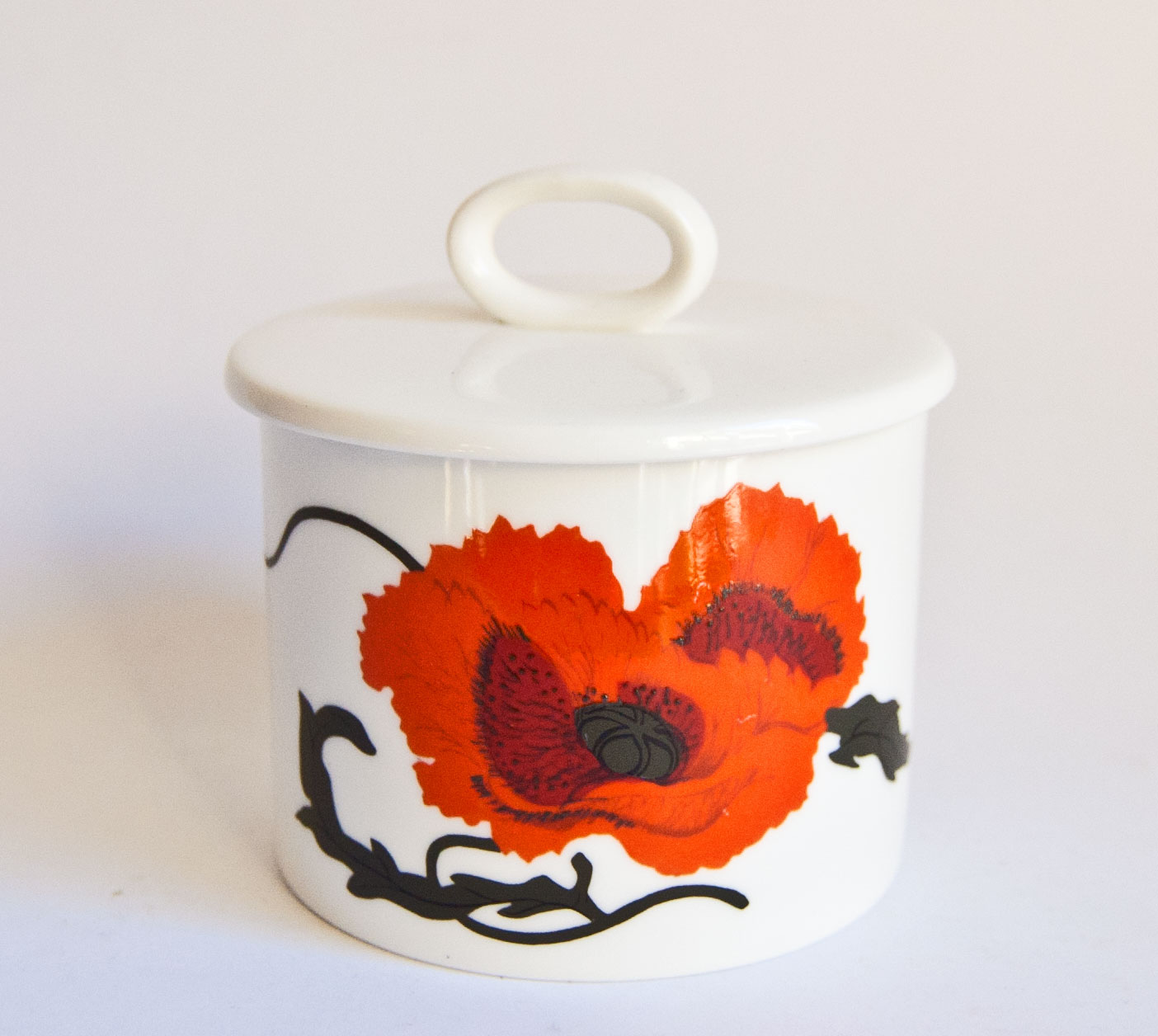
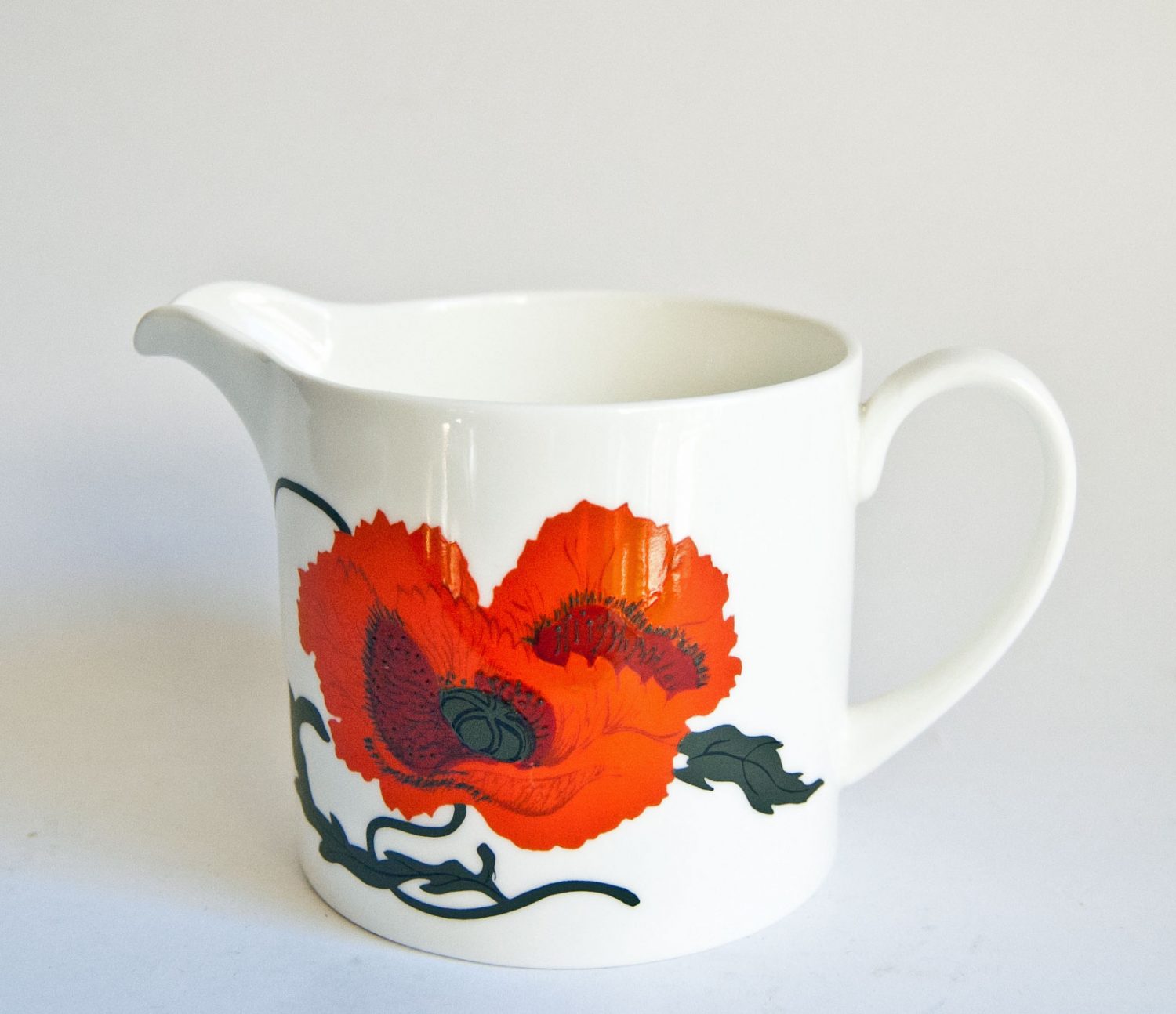
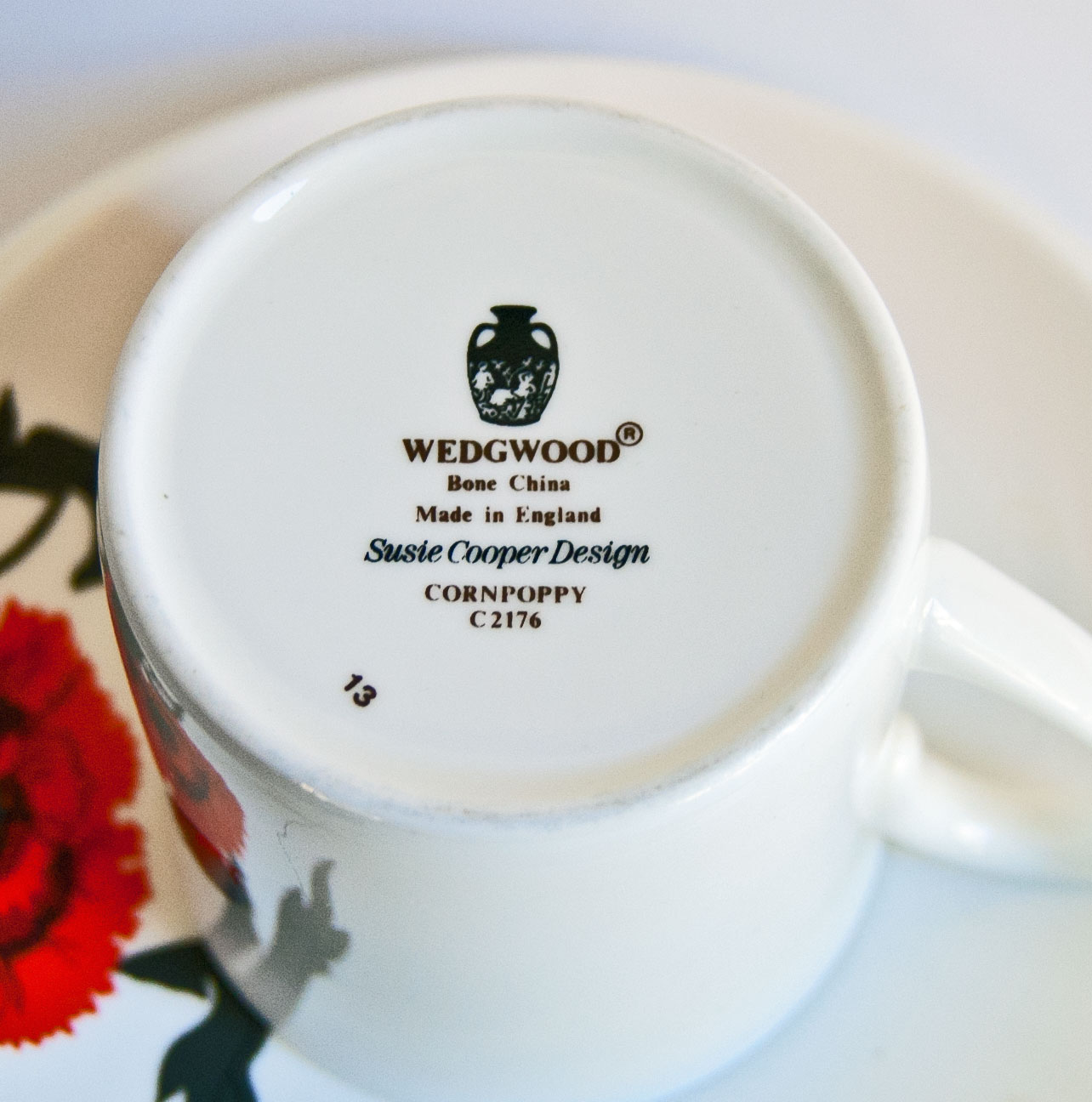
Susie Cooper ‘Cornpoppy’

Susie Cooper (1902-1995) was one of the most prolific and talented ceramic designers of the 20th Century….. if not THE top designer of ceramics in the 20th Century. I have several entries on this website with my favourite Susie Cooper patterns.

Susie Cooper’s career spans over 7 decades from when she founded the Susie Cooper Pottery in 1929 until the late 1980s. I’ve never come across a design by her which I don’t admire. I especially like her Art Deco era pieces, but it is also her 1960s and 1970s designs which stand out from the crowd.

Her patterns are always beautifully balanced, with an exquisite attention to detail which many designers neglect. She also knew the importance of the clay body and form on which the design was put, and stated in the 1950s that “The beauty and translucency of china should speak for itself and not be overburdened by pattern” – I think that this view is demonstrated in one of her stand out 1970s designs – “Cornpoppy” (1971) from her Wedgwood period.

There is a complex depth of colour and texture in the orange and red of the poppy, and the black flowing lines contrasted against the bright white clay body remind me of the beauty of Japanese and Chinese calligraphy.

In the very thoroughly researched and written book “Susie Cooper, A Pioneer of Modern Design” by Andrew Casey & Ann Eatwell, about “Cornpoppy” they write:

“The pattern, almost oriental in the stark contrast between the scarlet poppy and touches of black against the white bone china, demonstrates …her claim that a well designed article of pottery contributes to the interior design of the home. It is impossible not to sense the joy of the artist in this floral motif with its flowing lines and vibrant colour, unrestrained by the rimless coupe shape…..of course Susie Cooper had always been famous for her depiction of flora, but this was quite a departure from the combination of gentle pastel colours and creamy earthenware body of the 1930s. 

Here are a few pieces of Cornpoppy I have had hold of recently:


Susie Cooper Cornpoppy

Susie Cooper Cornpoppy – Photo Ray Garrod

Susie Cooper Cornpoppy

Susie Cooper Cornpoppy – Photo Ray Garrod

Susie Cooper Cornpoppy

Susie Cooper Cornpoppy – Photo Ray Garrod

Susie Cooper Cornpoppy

Susie Cooper Cornpoppy – Photo Ray Garrod

Susie Cooper Cornpoppy

Susie Cooper Cornpoppy – Photo Ray Garrod
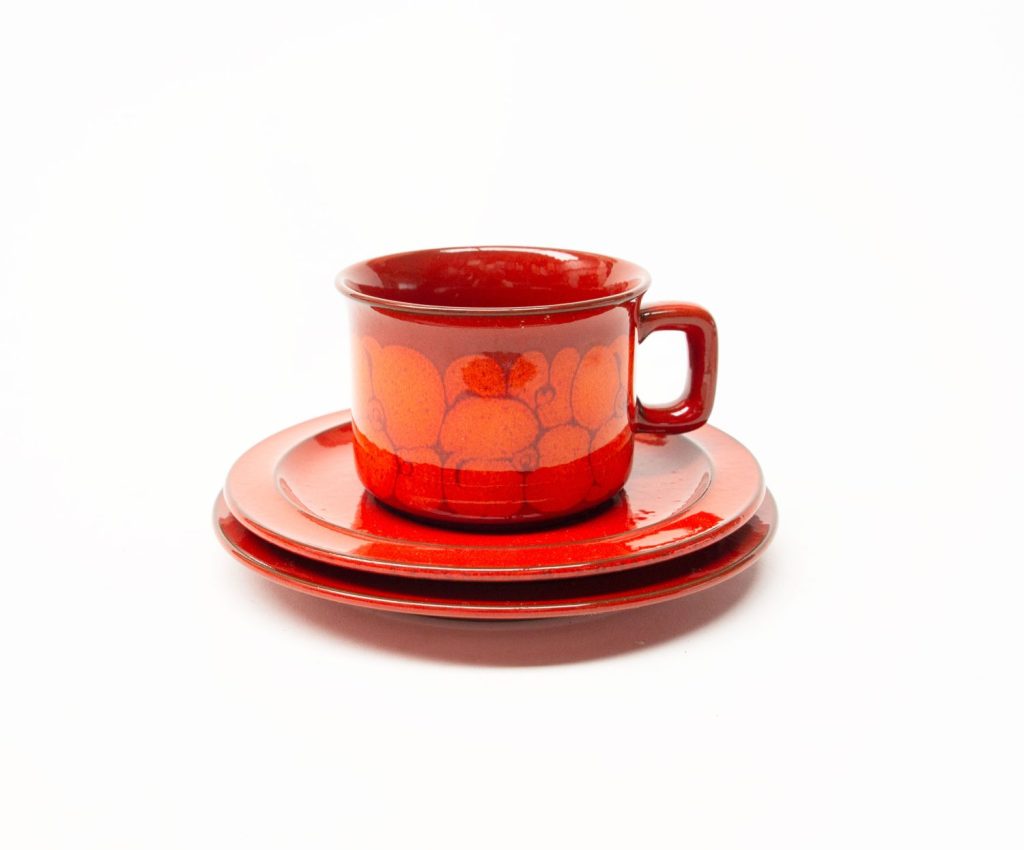
 

Stogo Demark Stoneware Dinnerware

I’ve written previously about the Danish Potter Herluf Gottschalk Olsen. As well as his own studio pieces he produced high quality, hand made production ware at Stogo Pottery Denmark (which was formerly Mørkøv Ceramics founded in 1940 by Peter Hansen

Stogo Pottery closed in the mid 1980s, but Olsen died much earlier in 1968 at aged just 52. This dinnerware setting by Olsen appears to be from the early 1960s – and is the one you will find most often from Stogo Pottery today – the lack of wear on pieces is a testament to its toughness and durability.

The dinnerware consist of high stoneware fired pieces, with a typically fritted dark Danish stoneware clay. The colour of the clay bleeds through beautifully into the light highly glossy pinkish oatmeal colour glaze on them. I love the detail on the pieces like the ridges on the handles of the cups, and the grips on the creamer – in addition to the beautifully made, sophisticated, and well designed forms.

Stogo Denmark
Stogo Denmark
Stogo Denmark
Stogo Denmark
Stogo Denmark
Stogo Denmark
Stogo Denmark
Stogo Denmark
Stogo Denmark
Stogo Denmark- Cereal Bowls
Stogo Denmark
Stogo Denmark- Photo via Happy Moose Vintage Etsy
Stogo Denmark
Stogo Denmark- Photo Via Happy Moose Vintage Etsy
Stogo Denmark
Stogo Denmark- Creamer
Stogo Denmark
Stogo Denmark bowls