Skip to content

Posts from the ‘Danish Factory Potteries’ Category

Richard Manz, Denmark

Richard Manz, Denmark

Richard Manz (1933-1999), husband of Danish ceramicist icon Bodil Manz.

In earlier years Richard worked in Sweden, and even at Gustavsberg for a time. He also studied under Peter Voulkos at Berkeley University of California with his wife Bodil in the late 1960s.

In 1967 he started a studio with his wife Bodil in Starreklinte, Odsherred. They produced several joint works including murals and large sculptural pieces in addition to developing their individual styles. During this period Richard also produced work for Knabstrup pottery in Denmark.

In the mid 1970s they both lived in the town of Arita, Japan for a while – learning the skill of working with very fine translucent porcelain.

The first piece below is one I bought at auction some time ago. I think demonstrates Richard’s mastery of the cylindrical form, for which he (and Bodil) have become so well known for.

While it is a stoneware piece, it is beautifully thin and fine and has been fired to the upper limit for stoneware (around 1300c) making it very hard (and giving it a beautiful sound if you “ping” it) .

The piece displays an obvious mastery of form and the beautifully controlled textures and glazes. I am guessing it would be from the early 1970s.

Richard Manz Denmark

Richard Manz Denmark

Richard Manz Denmark

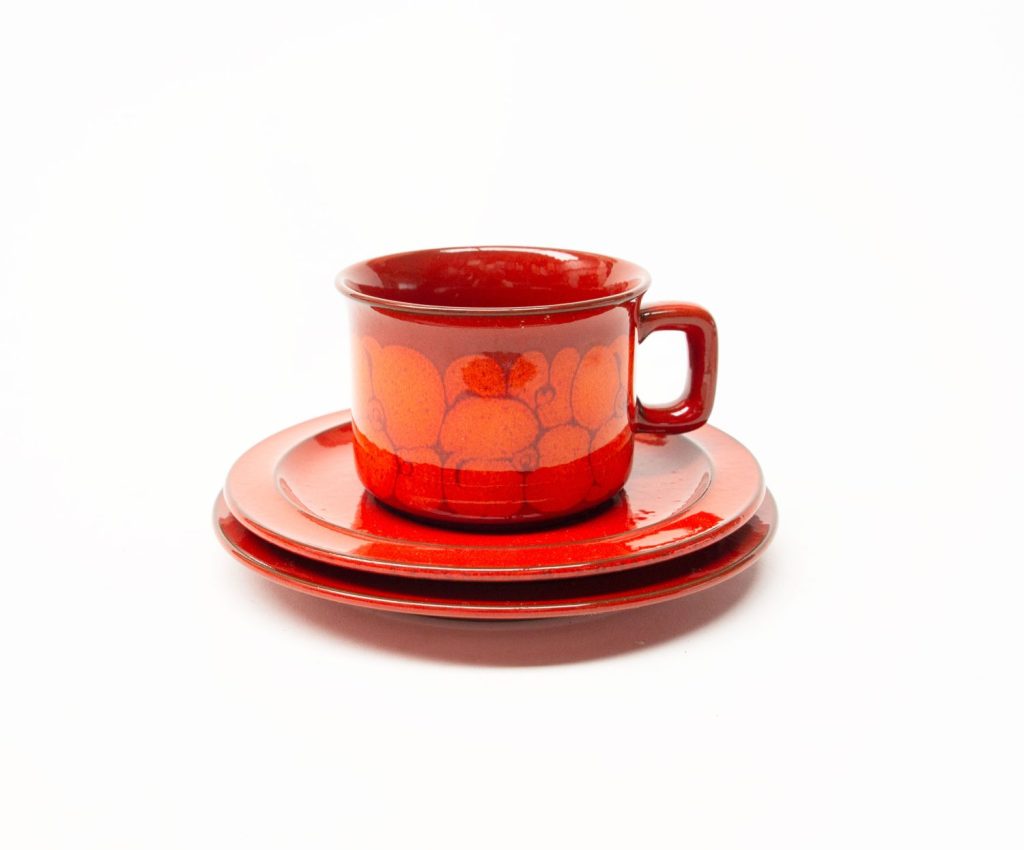
Richard Manz for Knabstrup, Denmark

Richard Manz for Knabstrup, Denmark

Richard Manz for Knabstrup, Denmark

Richard Manz for Knabstrup, Denmark

Read more

P. Ipsens Enke Denmark, Dekorativglasur

Ipsen's Pottery established in 1843 by potter Rasmus Peter Ipsen (1815-60) from Bornholm. Peter died early and his widow Louise Ipsen continued what her husband had started – and the factory became known as Ipsens Enke (Ipsen’s Widow). Read more by subscribing for a small monthly fee.

Read more

Royal Copenhagen, Bing Grondahl “Plaquettes” – Mini Wall Plates 1960s

Royal Copenhagen, Bing Grondahl “Plaquettes” – Mini Wall Plates 1960s

I wasn’t getting far finding out much about the origin of these small midcentury Danish wall plates until I found a comprehensive entry on Wikipedia where there is the very informative entry below.

The secret in finding a link to relevant information on the web was apparently to use the word “plaquette” instead of “mini-plate”, “commemorative plate” or “royal Copenhagen plate” etc.

“Royal Copenhagen  no. 2010 plaquettes are a series of small, collectable plates produced by Danish factories, Aluminia and Royal Copenhagen. The numbered and named series of 80mm faience miniplates or “plaquettes” are generally round, though a few are square. The most common colours are moderate to deep blue on a white background, though some have additional colours.

On the front, each has a scene depicting boats, landscapes, people, animals, steeples, buildings, statues, bridges, windmills, and more. Some also have a date on the outside edge. A variety of artists have provided the detailed artwork, including Kai Lange, Jørgen Nielsen, and Sven Vestergaard

On the back, each plaquette has two pierced holes so the plaquettes can be hung for display. In addition to the number 2010, most (though not all) have an identification number, along with a description (usually in Danish, all capital letters) of the front scene. Some have the words “ROYAL COPENHAGEN DENMARK FAJENCE”, or just ‘DENMARK”. Some have the factory mark, three wavy lines one atop another. Some have a monogram. Some have the Royal Copenhagen modified beehive mark: a capital “A” representing the Aluminia factory with three wavy lines, representing Royal Copenhagen, as cross strokes. All plates manufactured after 1969 have a crown and the words “Royal Copenhagen Denmark”.

Earl Nelson Newman wrote and privately printed a small hard-cover book in 1973 entitled “The Danish Royal Copenhagen Plaquettes: 2010 Series”. This book contains pictures and descriptions of plates #1-#85, and the special series featuring American Presidents, zoo animals, and antique autos.

Because there was nearly no information/literature about the “2010” Series, Carsten Pedersen (a collector himself) wrote a collector’s catalogue.. The catalogue describes about 448 miniplates (plaquettes) from the “2010” series and other series (old and new) from Royal Copenhagen, Aluminia, Köbenhavns Fajancefabrik and Bing & Gröndahl, Copenhagen. The catalogue was privately printed and entitled “Royal Copenhagen, Aluminia, Bing & Gröndahl – Plaquetten-Miniplates Series 2010 and special editions”


Read more