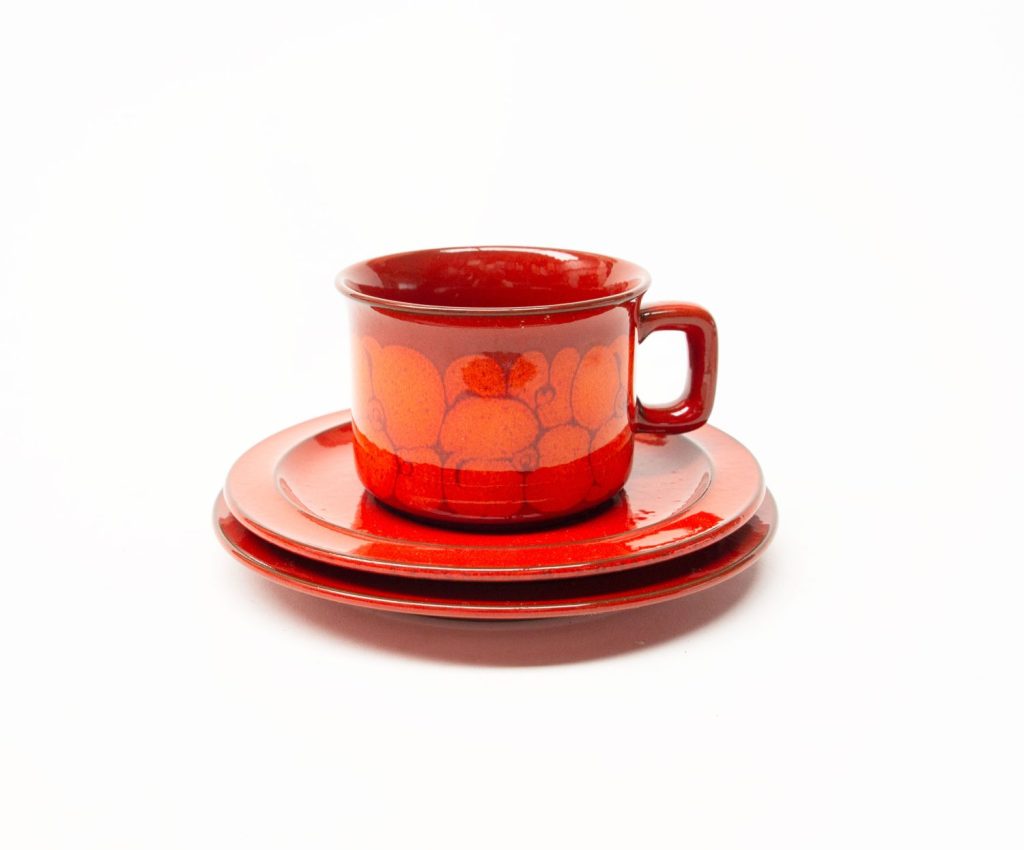
My interest in 20th Century ceramics starts to wane a bit in the late 1970s, but occasionally I come across interesting designs or stories from later.
This is a Royal Copenhagen design you don’t see that often, but was very popular when it was released in the early 1980s. The design is called “Picnic”. Strangely enough it is a design that rarely turns up nowadays. To me it typifies the flat, clean and bright design of the 1980s.
There were 6 different patterns in this series, with the forms designed by Grethe Meyer, and the graphics by Ole Kortzau. Interestingly, both of these designers initially worked as Architects but are now better known for their work in other design fields.
Royal Copenhagen “Picnic” – 1980s
Royal Copenhagen “Picnic” – 1980s – Backstamps
Ole Kortzau is well known for his series of Danish beachscape postcards from the 1970’s-1980’s which obviously influenced the bright, fresh designs of “Picnic”. He also designed for Georg Jensen, Holmegaard, Kvadrat amongst others. Read more
Jorgen Mogensen, Danish Potter (1927-2017 Denmark), Mid Century, Modernist Danish Pottery
I believe Jørgen MOGENSEN is one of the 20th Century’s most important Danish potters and sculptors. I love the sculptural qualities of his work and the way he uses glazes to accentuate the textural quality of his pieces. His pieces are all beautifully formed – and nearly always quite heavy and sculptural.
Mogensen trained at the Art Craftsman School in Copenhagen, and then studied for a period in Paris. He started his professional career as a potters apprentice with Royal Copenhagen in 1949. He worked with iconic figures such as Knud Khyn, Axel Salto, Gerd Bogelund and Nils Thorsson in their “stoneware cellar” where this group worked at Royal Copenhagen.
His first work for Royal Copenhagen were his 1950s pieces of stylised bird motifs with a mottled brownish stoneware glaze – a similar glaze to which the other stoneware artists were using during this period. He rarely used other glazes or colours – but you can sometimes find a design in blues.
The pieces below are all pieces I have owned by Jorgen Mogensen. The first piece I had was the squared vase form, which I was so drawn to it eventually led me to discover a whole world of Danish Mid-Century pottery which I have been researching, learning and writing about ever since.
I believe Jorgen Mogensens work to be generally under-rated and under-valued compared to the work of his peers at Royal Copenhagen like Axel Salto, Gerd Bogelund etc.
Jorgen Mogensen, Royal Copenhagen, Shallow Bowl FormJorgen Mogensen, Royal Copenhagen, Shallow Bowl FormJorgen Mogensen, Bird Vase Form, Royal CopenhagenJorgen Mogensen, Small Dish, Royal CopenhagenJorgen Mogensen, Large Vase, Royal CopenhagenJorgen Mogensen, Royal Copenhagen, Thrown Bowl Form with Toucan Design – Very Rare
Jorgen said that his figures of animals were influenced by a visit to a Mexican exhibition in Sweden – and it had such influence on him that he developed his own style based on it that was to stay with him for the rest of his career.
In 1965, frustrated with working at Royal Copenhagen – Mogensen started his own studio where he produced highly original pottery and monumental sculpture – most of which was in a “primitive” Nordic style which demonstrated his great skill at combining sculpture and ceramics.
Jorgen Mogensen, Own Studio, Slab FormJorgen Mogensen, Own Studio, Slab FormJorgen Mogensen, Own Studio, Thrown PlatterJorgen Mogensen, Own Studio Bowl
Production ceased in the studio around the late 1980’s. The studio pieces are signed with his easily recognisable signature and usually “Denmark” stamped on. They also usually have a letter followed by 3 numbers as identifiers.
Jorgen Mogensen, Own Studio Signature
In 1991 Mogensen retired from Ceramics and painted until 2003. His wife Ursula Prinz Mogensen who also worked at Royal Copenhagen, and then along side Jorgen in his studio is a well known ceramicist in her own right.
Jorgen Mogensen in his studio 2009 – Photo by the archived site Simplymodern.dk who have an interview with Jorgen in his studio.
The iconic Royal Copenhagen Ildpot series by Grethe Meyer (1918-2008). Series produced from 1976 into the 1980’s.
Grethe was one of Denmark’s most important 20th Century designers, Architect, furniture designer, product designer and more. Although she dedicated herself to a career in architecture, she gained an international reputation for her glassware and ceramic designs. Her high-integrity designs reflected Meyer’s belief that “one should buy fewer items of better quality”, along similar principles to what has become known as a Scandinavian design aesthetic.
The first time I heard of Grethe Meyer was when I bought two pieces from her “Ildpot” series from Royal Copenhagen in the 1970’s. I was intrigued by their beauty and “brutalist”simplicity.
The Ildpot series was an example of adaptation to a new twentieth century lifestyle: the busy person working outside the home can put the bowl directly from the freezer in the oven, grill or microwave, and let the finished dish simmer while performing other chores. The design was very versatile – the lid could also be used as a plate, or placed onto heat insulating teak plates.
Among Meyer’s other works are superb pieces of furniture, designed together with Børge Mogensen, A glass series “Stub” for Kastrup along with Ibi Trier Morch; “Blakant” (Blue line), “Fire-Kettle” (Ildpot) and “Hvidpot” (White Pot) for Royal Copenhagen; and the cutlery series “Copenhagen” for Georg Jensen. All of her work has a timeless quality.
From the official Royal Copenhagen site:
Artist and architect in one:
Grethe Meyer is not just an artist, but at least as much of an architect with a very special eye for how functionality can be combined in poetic expression. With these two areas of focus, her solutions are beautiful and eternal elements that form part of our everyday lives. Grethe Meyer completed her training as an architect at the Academy of Arts in Copenhagen in 1947. She was influenced by the unique functionalism that existed in Denmark from the late 1930s to the late 1950s. She may, in fact, be the prime example of the shared enthusiasm for aesthetic simplicity and perfect craftsmanship that goes by the international style appellation of Danish Design.
With an eye for habit:
Simplicity is characteristic of all Grethe Meyer’s work. But simplicity does not happen by itself. It is the result of detailed observation, experience and analysis of our habits. It is also the foundation for Blue Line from 1965, which was Grethe Meyer’s first big success at Royal Copenhagen. The shapes in Blue Line are precise and timeless, and they have been carried forward into other series such as “4 All Seasons”.
Royal Copenhagen Ildpot – Grethe MeyerRoyal Copenhagen Ildpot – Grethe MeyerRoyal Copenhagen Ildpot – Grethe MeyerGroup of Royal Copenhagen Ildpot Forms – photo by Lauritz.comRoyal Copenhagen Ildpot Label