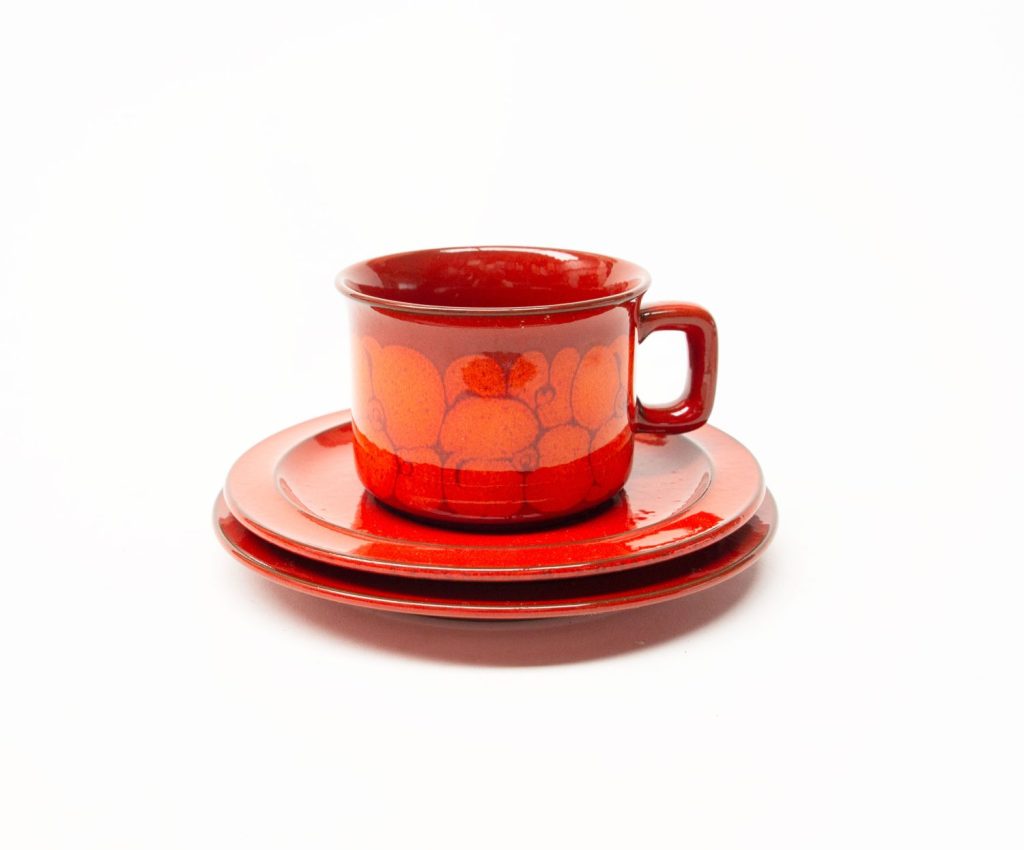
While the award winning and amazing “Persia” glaze at Michael Andersen & Sons was developed in the 1930s by Daniel Andersen (1885-1959) and used on pieces from that date, I think it is the designs of Marianne Starck at MAS & Sons in the 1950s and 1960s where the Persia glaze is seen at its best.
This complex glaze turns out differently on each piece, depending on the glaze colourants used and style of decoration. Sometimes it appears like a pearlescent multi coloured micro-mosaic, and at other times as a more subtle pattern decoration with grey pearlescent hues. Often the pieces using this glaze have beautiful but subtle oxidisation of the glaze, giving some of the colours a slightly metallic appearance – especially noticeable on the red colour of the Viking longboat in the first image below.
The glaze is also surprisingly smooth and silky to the touch. The Persia glaze was used on all types of forms – from utilitarian pieces to sculptural forms.
Below are some of my favourite pieces using the Persia glaze.
Michael Andersen Denmark, Persia Glaze Bowl, Marianne Starck – Photo Ray GarrodDetail – Viking Design on Michael Andersen Denmark, Persia Glaze Bowl, Marianne StarckMichael Andersen Denmark, Persia Glaze Lamp, Marianne Starck, Photo Ray GarrodMichael Andersen Denmark, Persia Glaze Bowl, Marianne Starck, Photo Ray GarrodMichael Andersen Denmark, Persia Glaze Dish, Marianne Starck, Photo Ray GarrodMichael Andersen Denmark, Persia Glaze Bowl, Marianne Starck – On this piece the Persia glaze effect is much more subtle, because of the large areas of colour in the design. Photo Ray GarrodMichael Andersen Denmark, Persia Glaze Dish, Marianne Starck, Photo Ray GarrodMichael Andersen Denmark, Persia Glaze Dish, Marianne Starck – Photo via DanishMood on EtsyMichael Andersen Denmark, Persia Glaze Mirror Frame, Marianne Starck – Photo via CopenhagenBlack on Etsy
Michael Andersen and Sons Pottery (MAS), Bornholm Denmark.
Michael Andersen & Sons was founded in the 1880s (from an earlier 18th Century Pottery) on the island of Bornholm, Denmark – one of the major centres of Danish pottery production during the 19th and 20th Centuries.
Jens Michael Andersen (1859-1931) who was the founder, had trained at the local Hjorth pottery.
His 4 sons worked in the pottery, and one son, Daniel (1885-1959) developed the iconic “Persia” glaze in 1935, which won an international award. The Persia glaze went on to be used on many designs well into the 1960s.
Persia Glaze Bowl with design by Marianne Starck, M.A.S. Denmark – The cat designs by Marianne Starck on different forms with a Persia glaze have become very collectable pieces.Michael Andersen & Sons, Lamp with Persia Glaze – A simple blue pattern on the Persia glaze like this one seems to show it of to best effect – highlighting the lovely mother-of-pearl crackle of the glaze
It is the “Art Pottery” of the 1950s -1970s which MAS are now best known for worldwide…but I also love some of the Art Deco style designs from the 1930s – although these are harder to find in excellent condition now.
Michael Andersen & Sons, Art Deco Era Bowl
Marianne Starck originally from Germany, was one of the top Ceramicists who contributed to the success of Michael Andersen & Sons Pottery in the mid 20th Century.
She started with the Factory as Artistic Director in 1955 and remained until its closure in 1993, designing many iconic series of which the “Negro” series is probably one of the most coveted now.
“Negro” Series Bowl, Marianne Starck, M.A.S. There are a large number of designs in the “Negro” or “Tribal” series – all very striking in design
Marianne’s work is usually inscribed with the initials M.S.
Michael Andersen Denmark, MS signature for Marianne Starck
Since 1930 items from MAS have usually been marked with the three fish stamp in various designs. Sometimes it is a simple label, other times just an impressed mark of 3 herrings.
Michael Andersen & Sons Denmark, 3 Herrings Paper Label
The 3 herring mark is also the official seal of the town of Ronne, where the factory was located.
The M.A.S. pottery was partly resurected by ceramicist Solveig Ussing, and it operates currently from a small workshop in Ronne, where some of the original MAS moulds are still used.
The photographs in this article are of pieces that have passed through my hands, so of course they only represent a fraction of all of the designs made.
Stoneware Bowl, Michael Andersen & Sons, Marianne Starck Design. The stoneware pieces from the 1960s and 1970s also have a presence and quality which set them apart from the rest.Marianne Starck Wall Plaque, M.A.S.Michael Andersen & Sons, Large Stoneware BowlMichael Andersen & Sons, Stoneware Bowl. These small stoneware forms from the 1960s – often with blue glaze, and textured clay are amongst my favourites from M.A.S.
Visit my C20CERAMICS SHOP on Etsy
Rorstrand "Eden" c1960s
OR If Etsy is unavailable, or you would prefer eBay - follow the link below (click on the image) . Basically the same items are listed, at the same price.