Skip to content

Posts tagged ‘1970s’

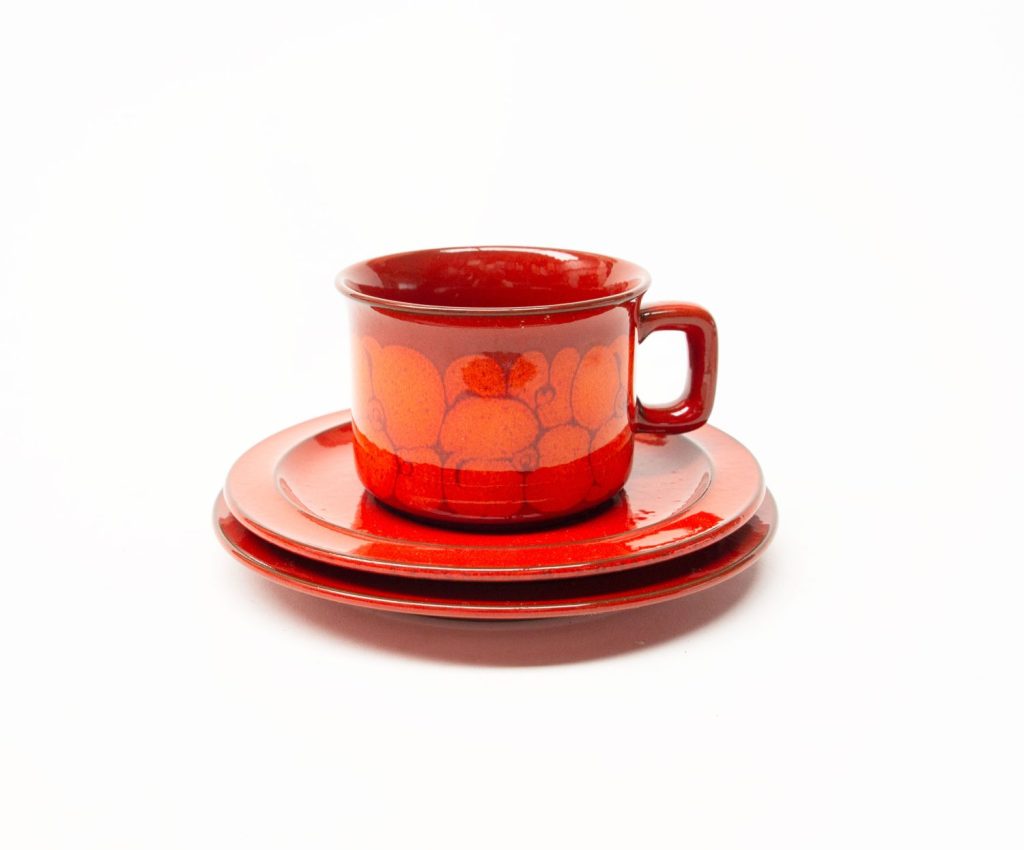
Mexico Design, Kronjyden Nissen, Denmark

“Mexico” Kronjyden Nissen, Denmark.

At the end of the 1960s into the 1970s a new group of series was produced by Kronjyden Nissen Denmark, all on the same shape (form no 38). This group of designs started with Tema, then followed closely with Mexico & Columbia.

It is often purported that these designs were by Jens Quistgaard – but there seems to be no documentation around this. One theory is that he did design them, but did not want his name attributed to the designs due to a perceived conflict of interest with his Dansk Design company. To me looking at the forms and the decor of Tema & Mexico, they look and feel like designs by Quistgaard, but without a clear record this can not be confirmed.

Tema became the highest selling dinner service in Denmark at the time (mid 1970s) – although I find Mexico much more impressive looking and interesting. The way the Mexico glaze behaves on the form lifts the design to a whole new level, and lifts the otherwise plain and functional form of  Tema to me.

Peru on form 45, and Coppelia on form 46 followed, but interest in stoneware dinnerware was now starting to decline, and by 1988 Kronjyden Nissen closed and was taken over by Bing & Grondahl/Royal Copenhagen. B&G continued producing some of the designs for several years and you will often find services such as “Cordial”, “Rune”, & “Contrast ” with the Bing & Grondahl backstamp.

Mexico Design, Jug Form, Jens Quistgaard, Kronjyden Nissen

Mexico Design, Jug Form, Kronjyden Nissen


Mexico Design, Sugar Bowl, Jens Quistgaard, Kronjyden Nissen

Mexico Design, Sugar Bowl, Kronjyden Nissen


Mexico Design, Large Tea Cup Jens Quistgaard, Kronjyden Nissen

Mexico Design, Large Tea Cup Kronjyden Nissen


Mexico Design, Teapot, Jens Quistgaard, Kronjyden Nissen

Mexico Design, Teapot, Kronjyden Nissen

Read more

Derek Smith, Australia

Derek Smith was a already an accomplished ceramic designer and art teacher in the U.K. when he moved to Australia in 1956.

He set up a studio and kilns while he was teaching at Bowral High School in the Southern Highlands of New South Wales, near Sturt Pottery where Smith developed working relationships with the potters there at the time.

Read more

Arabia Ruska – Ulla Procope

Arabia Ruska – Ulla Procope

Ulla (Ulrika) Procope (1921-1968) worked in Arabia’s art department at the same time as Kaj Franc, Kaarine Aho, and Goran Back. Initially she trained with Olga Osol in the hand painting department at Arabia, after graduating as a ceramicist from the Central School of Arts & Crafts in Helsinki. She worked at Arabia from 1948-1967.

Ulla was a skilled wheel thrower who understood how clay worked, and her outstanding design skills along with the ability to create production models, contributed to the success of Arabia in the 1950s and 1960s.

The Ruska range which she designed for Arabia Finland in 1960 became one of the best selling lines in their history. Its production was continued into the 1990’s it was so popular. It has become a Scandinavian design classic.

It was the first time Arabia  had used a matte glaze for mass produced utilitarian ware. Ruska had a handcrafted look and feel to it, with the glaze colour and mottled appearance turning out slightly differently on each piece.

Arabia Ruska Teapot
Arabia Ruska Teapot
Arabia Ruska Milk Jug Creamer
Arabia Ruska - Large Coffee Cup
Arabia Ruska – Large Coffee Cup
Arabia Ruska - Bowl
Arabia Ruska – Bowl
Arabia Ruska - Wide Cup (Soup)
Arabia Ruska – Wide Cup (Soup)
Arabia Ruska - Coffee Cup
Arabia Ruska – Coffee Cup
Arabia Ruska Coffee Pot
Arabia Ruska Cereal Bowl

Being stoneware it was also very tough and ovenproof. A trend at the time was ‘oven to table’ and Ruska was perfectly designed for this purpose.

Ruska  captured the look and feel of an era in the 1960s and 1970s, and is still keenly sought after on the secondary market as replacements, and for those just discovering this classic Scandinavian design.

The same model forms (Model S) were used for the later Anemone and Rosmarin and Kosmos designs.