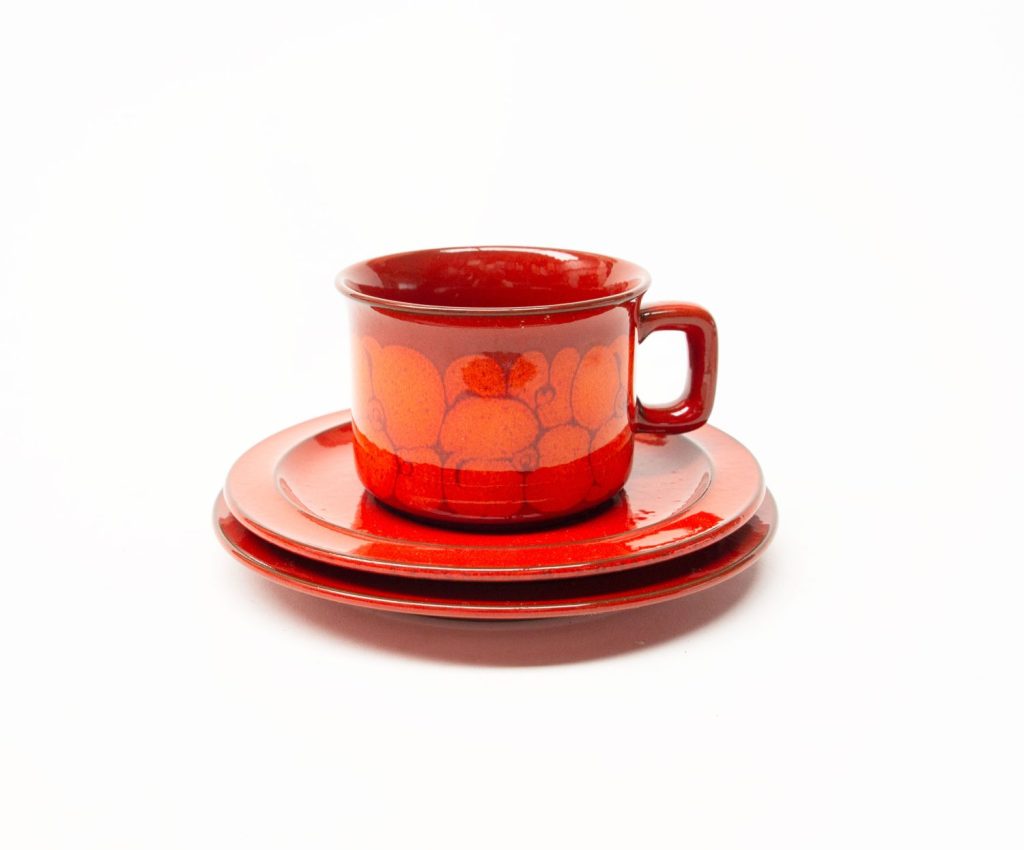
This maker, “Edno Denmark” remains a mystery, so I would love to hear from any reader who knows a little more about the maker in the comments below.
Ive been searching from time to time online for many years to see if anyone has identified who produced the pottery and where it was located – but without success. I have the feeling the letters are an acronym.
Items for sale appear more frequently now than they used to, mainly on the Danish site DBA and occasionally on Etsy
The pieces are earthenware fajance, glazed with a white tin base glazed and then hand painted with an overglaze pattern.
Most pieces appear to be from the 1950s or 1960s.
Edno Denmark, Photo Ray Garrod Edno Denmark, Photo via Auctionnet Edno Denmark, Photo via DBA dk
I found the interesting little piece of pottery in the first 3 images some time ago, and only just recently stumbled on its maker. Originally I read it as “Dybdahl” but of course it is not even in their style. It is a piece by Max Thorsbro Pedersen from Denmark c1950s from his Dybbøl Pottery in South Jutland Denmark.
I found a little about Max from the Danish website for Broager.dk – a community website for Broager.dk, designed for the use of the citizens of the city and region around Broager. The website has some history of the Ceramics and Art of the area, including how Max Throsbro Pedersen fits in to the story.
“After the closure of the Broager Railway in 1932, the station building in Broager has been used for various purposes, most recently as a station inn. In 1937, manufacturer C H Clausen opened a pottery workshop, Broager Keramik, in the station building with Ingemann Nielsen as potter. In 1945, the pottery passed to Max Thorsbro Pedersen, who employed three journeymen, three apprentices and three ladies, who mainly decorated the pottery.
Broager Keramik produced small and large vases, Aladdin lamps, milk jugs, maternity pots, dishes and dolls’ frames and ashtrays.There is still a lot of ceramics from Broager Keramik, especially in Broagerland, where Broager Church’s twin spiers are stamped on the back of the goods.
In 1959, Broager Keramik closed and Max Thorsbro Pedersen opened a small pottery workshop in Dybbøl“
It is unclear how long the pottery run by Max Pedersen in Dybbol operated until….if anyone knows contact me and I can fill in the gaps. I would also be interested to see more of his work – there doesn’t seem to be much of it around online.
Max Thorsbro Pedersen- Dybbøl Pottery – Photo Ray Garrod
Max Thorsbro Pedersen- Dybbøl Pottery – Photo Ray Garrod
Max Thorsbro Pedersen- Dybbøl Pottery – Photo Ray Garrod
I also found these interesting pieces on Etsy:
Max Thorsbro Pedersen- Dybbøl Pottery – Photo via Etsy store “LikeADanish”
Max Thorsbro Pedersen- Dybbøl Pottery – Photo via Etsy store “LikeADanish”
Max Thorsbro Pedersen- Dybbøl Pottery – Photo via Etsy store “LikeADanish”
…AND this fantastic large piece I noticed on 1stDibs.
Max Thorsbro Pedersen- Dybbøl Pottery- Photo via 1st Dibs
Bangholm Pottery started operation in 1948 in Skodstrup, near Aarhus Denmark, by Knud Nielsen and his father (also a potter).
The types of wares consisted mainly of domestic and utilitarian items for the home. It reached the height of popularity in the 1950s and 1960s, and became known for its’s colourful striped fajance glazed terracotta pottery which has continued in popularity on the secondary market.
The business was eventually taken over by Iben Scott Lundby, a close friend of the family. Iben had started with Bangholm in 1969 as a trainee who qualified as a potter in 1973. Iben worked with Bangholm from until 1990 when she took over the pottery. In 1998 the pottery was moved to nearby Ebeltoft. Here the focus was more on unique and one-off ceramics.
Bangholm Pottery in later years evolved into a different business, still run by Iben Scott Lundby….which as at 2023 appears to be no longer operating or have a website. The quote below is from the website of Scott Lundby when the business was operating when this article was originally published in 2017.
“My name Iben Scott Lundby. I was skilled as potter in 1973 in the family business ”Bangholm Keramik”. After education I continued in the pottery with throwing and painting until 1991. Here I took over the business after my parents, who have had a long and exciting life as potters.
The next 8 years, I continued this business with serial production and wholesale of Bangholm Keramik for shops primarily in Denmark, Norway and Sweden. Gradually the throwing and decoration work began to drain the physics, and by the millennium, I decided to move the company to Ebeltoft, where the focus should be more unique work, smaller production, and only with retail sale from my own store.
After a short time in Ebeltoft, I succeeded in taking over a smaller property on Adelgade 4 in Ebeltoft, near the city’s small and famous old town hall. Here we got a good business location for our store supplied with a workshop building, which allowed organization of a slightly more intimate ceramic atelier for the throwing and painting work.
Now this business has evolved into a lifestyle store with retail sales of jewelry, womenswear, accessories, shoes, and handicrafts. More recently we have completed the physical store with this webshop as a natural additional sales channel.Today we enjoy a fantastic feedback from our customers, which gives us faith in a good development of our business”
Most of the pottery you will find by Bangholm is earthenware-terracotta, with a white tin glaze base – and coloured overglaze. Otherwise referred to as Fajance or Faience. Occasionally I have seen unglazed or partly glazed pieces, but not often.
The images below (except for the impressed backstamp) are all taken by me – you may find them much copied and mis-attibuted around the web – but most are from my original post on Bangholm Pottery on Blogger in 2011, and 2 later posts.
Bangholm Denmark Bowl and Plate with Striped GlazeBangholm Denmark Bowl and Plate with Striped GlazeBangholm Denmark TerrineBangholm Denmark, Striped Ewer Form
There are 2 known signatures – one a hand-painted script, and the other an impressed stamp – which I presume is later.
Bangholm Denmark SignatureBangholm Denmark, Impressed Stamp Via “silottesdk” on EtsyBangholm Denmark, Plates with striped Patterns – a much copied image around the WWW.
OR If Etsy is unavailable, or you would prefer eBay - follow the link below (click on the image) . Basically the same items are listed, at the same price.